To calculate peptide concentration, divide mass in milligrams by diluent volume in milliliters. For example, 5 mg in 2 mL gives you 2.5 mg/mL. Always use the actual measured volume, not the estimated fill level. Want molar units? Convert to µM using µM = (mg/mL × 1,000,000) ÷ MW. Record both mg/mL and µM for comparison. Then verify your result and watch for common errors, details comes next. Using a peptide concentration calculator can simplify your workflow significantly. This tool allows you to easily convert and compare various concentrations.
Key Takeaways
- Calculate concentration in mg/mL by dividing peptide mass (mg) by diluent volume (mL); for example, 5 mg in 2 mL equals 2.5 mg/mL.
- Plan reconstitution volume using volume = mass ÷ desired concentration, and record the exact measured diluent volume added.
- Convert to molar units with µM = (mg/mL × 1,000,000) ÷ MW (g/mol), using the peptide’s correct molecular weight.
- Verify results by recalculating mass ÷ volume and confirming with UV absorbance methods like A280 or (A215 − A225) × DF × 0.144.
- Avoid common errors such as wrong fill volume, incorrect MW, unit conversion mistakes, and omitting the 1,000,000 factor or dilution factor.
How do you calculate peptide concentration for research samples

Peptide concentration for research samples is calculated by dividing the total peptide mass by the diluent volume: mg/mL = mass (mg) ÷ volume (mL). Read your vial label and certificate of analysis for the starting mass and molecular weight. If you’re planning reconstitution, calculate the volume you need with volume = mass ÷ desired concentration. Using the peptide concentration and volume calculator can help streamline your process. This tool ensures that you accurately determine the necessary diluent volume for your samples.
For example, if you dissolve 5 mg in 2 mL, you get 2.5 mg/mL by direct division. Accuracy depends on the actual volume you add, not an estimated fill level.
If your downstream assay requires molar reporting, convert using molecular weight: µM = (mg/mL × 1,000,000) ÷ MW (g/mol). Record both mg/mL and µM so you compare peptides by moles, not just mass.
What variables determine peptide concentration
Peptide concentration is determined by total peptide mass, diluent volume, and molecular weight. Your total peptide mass comes from the vial label or certificate of analysis, typically reported in milligrams. Divide that mass by the diluent volume you add in milliliters, and the concentration comes out in mg/mL. So 5 mg in 2 mL yields 2.5 mg/mL. Accuracy depends on the actual volume you add, not an estimated fill level, so measure your BAC water precisely.
For molar reporting, molecular weight becomes the third variable. Divide mg/mL by MW, then multiply by 1,000,000 to get µM. Make sure the MW matches your specific peptide sequence and form. Control these three variables carefully, and concentration is calculated reliably every time.
What information is needed before calculating
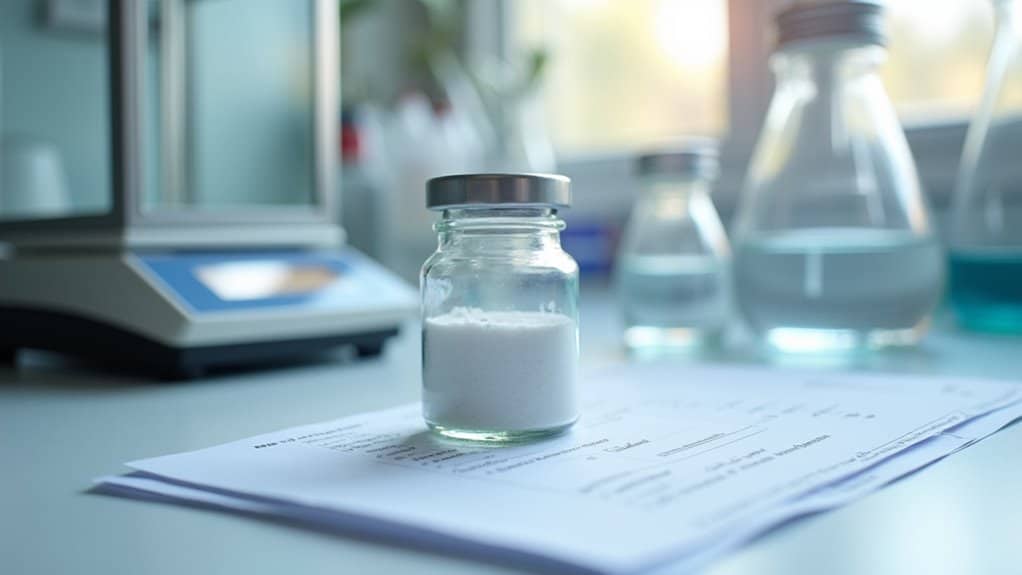
You need three pieces of information: the total peptide mass, the diluent volume, and the molecular weight. The mass and molecular weight are on the vial label and certificate of analysis. The mass, reported in milligrams, is your starting point. The molecular weight, in g/mol, lets you convert mg/mL into molar concentration later.
The diluent volume is the amount of solvent, typically BAC water, added during reconstitution. Record the exact volume you add, not an estimated fill level, because accuracy here directly determines your result.
If you’re planning the reconstitution, decide your target concentration too. Then you can apply volume = mass ÷ desired concentration to determine how much solvent to add before mixing.
How do vial mass and diluent volume interact
Vial mass and diluent volume determine concentration through a single division: concentration equals mass divided by volume. When you divide the total peptide mass in milligrams by the diluent volume in milliliters, you get concentration in mg/mL. Reconstitute 5 mg in 2 mL, and the result is 2.5 mg/mL by direct division. Vial volume vs peptide mass plays a crucial role in the preparation process. Understanding the relationship between these two factors ensures accurate dosing in various applications.
These two values move inversely. Hold the mass constant and add more solvent, and your concentration drops. Add less, and it climbs. That’s why you calculate the volume you need before mixing: volume equals mass divided by your desired concentration.
Your accuracy depends on the actual volume you add, not an estimated fill level. Measure the diluent precisely, and your mg/mL result will reflect the true concentration.
How do you verify a peptide concentration calculation
Verify a peptide concentration calculation by recalculating mass ÷ volume with your exact reconstitution volume, then confirming with UV absorbance when the peptide contains aromatic residues.
| Method | Formula | Confirms |
|---|---|---|
| Mass/volume | mg ÷ mL | Stock mg/mL |
| A280 | A ÷ (ε × l) | Molar concentration |
| A215/A225 | (A215 − A225) × DF × 0.144 | mg/mL |
If your UV result lands within a few percent of your calculated value, you’re confirmed. If they diverge, recheck your added volume, dilution factor, and molecular weight before trusting the number for downstream molar reporting.
What calculation mistakes are most common
The most common calculation mistakes are using the wrong fill volume, molecular weight, unit conversion, molar conversion formula, UV dilution factor, or cross-check. The fill volume is most often estimated instead of measuring the actual solvent added, which skews your mg/mL immediately. You might use a molecular weight that doesn’t match your peptide’s specific sequence or salt form, corrupting every molar conversion. Watch your unit handling: mixing mg with µg, or mL with µL, shifts results by orders of magnitude. When converting mg/mL to µM, sometimes the 1,000,000 factor is dropped or divide by MW incorrectly. With UV methods, the dilution factor may be forgotten, or the A215 formula when absorbance exceeds 0.5. Verification may also be skipped for whether mass/volume math and absorbance readings actually agree.
Shop Research-Grade Peptides at Holas
Accurate peptide concentration and reconstitution calculations depend on starting with high-purity peptides you can trust. Holas supplies laboratory-grade research peptides, third-party tested and prepared under sterile handling standards for reliable research applications. Browse our shop or contact us to source the right peptides for your work.
Frequently Asked Questions
What Diluent Is Best for Reconstituting Research Peptides?
Bacteriostatic (BAC) water is typically the best choice for reconstituting research peptides, since it dissolves most sequences reliably. Whatever diluent is used, the exact volume added must be measured, because the concentration depends on it. Concentration in mg/mL equals total peptide mass divided by added volume, so adding 2 mL to a 5 mg vial gives 2.5 mg/mL. Accurate volume measurement is what keeps the calculation correct.
How Should Reconstituted Peptide Stock Be Stored?
Reconstituted stock is best stored frozen, ideally at −20°C for short-term use or −80°C for longer periods, in single-use aliquots so the same vial is not repeatedly frozen and thawed, since each cycle degrades peptide integrity. Each aliquot should be labeled with the concentration in mg/mL and µM, the reconstitution date, and the diluent volume. Minimizing light exposure and recording storage conditions keeps measurements accurate and reproducible.
Does Peptide Purity Affect the Calculated Concentration?
Yes, purity directly affects the calculated concentration. Dividing vial mass by diluent volume assumes 100% peptide content, but the stated mass often includes salts, water, and counterions. If a vial’s 5 mg is only 80% pure, the actual peptide is 4 mg, so the real concentration is lower. The certificate of analysis gives net peptide content, and the mass used in the calculation is adjusted accordingly.
Can I Recalculate Concentration After Diluting the Stock?
Yes. After diluting, the dilution factor is applied to the stock concentration by multiplying the stock’s mg/mL by the ratio of stock volume to total final volume. For example, diluting 1 mL of 2.5 mg/mL stock into 4 mL total gives 2.5 × (1÷4) = 0.625 mg/mL. To convert to µM, divide by molecular weight and multiply by 1,000,000. Tracking exact volumes keeps the result accurate.
Which Quantification Method Is Most Accurate for Peptides Without Aromatic Residues?
For peptides without tryptophan or tyrosine, the 215/225 nm UV method gives the most accurate results, using mg/mL = (A215 − A225) × dilution factor × 0.144. Keeping A215 below 0.5, diluting if it is higher, stays within the reliable range. Dividing by molecular weight and multiplying by 1,000,000 then gives µM. Since aromatic absorbance at 280 nm is unavailable for these sequences, this approach works better.