A peptide reconstitution calculator turns three inputs into precise dosing. You enter the vial’s strength, the bacteriostatic water volume, and your target dose. The tool divides mass by volume to find concentration, 10 mg in 1 mL gives 10 mg/mL. Then it calculates your draw volume and converts it to U-100 syringe units, so 0.1 mL equals 10 units. Get these numbers right and common mistakes are explained below.
Key Takeaways
- Concentration equals peptide mass divided by reconstitution volume, so 10 mg in 1 mL yields 10 mg/mL.
- Set diluent volume by dividing peptide mass by your target concentration, so 10 mg ÷ 5 mg/mL needs 2 mL.
- Determine draw volume by dividing target dose by concentration, so 1 mg from 10 mg/mL equals 0.1 mL.
- Convert milliliters to U-100 insulin units by multiplying by 100, so 0.1 mL equals 10 units.
- Enter accurate mass, diluent volume, and target dose, keeping units consistent to avoid dosing errors.
How does a peptide reconstitution calculator work
A peptide reconstitution calculator works by dividing peptide mass by reconstitution volume to determine concentration. You enter your peptide mass, the bacteriostatic water volume you’re adding, and your target dose. From there, the tool calculates concentration, for example, 10 mg in 1 mL gives 10 mg/mL. It then converts an amount to volume using target amount ÷ concentration. So a 1 mg dose from a 10 mg/mL solution equals 0.1 mL. Many calculators also translate that volume into U-100 insulin syringe units, multiplying mL × 100. That means 0.1 mL reads as 10 units. Some tools display concentration in mcg/mL when you enter micrograms. Always verify each input, since accurate mass and volume entries directly determine safe, correct dosing.
What inputs does peptide reconstitution require
Peptide reconstitution requires three core inputs: peptide mass, bacteriostatic water volume, and target dose. The inputs are the vial’s labeled strength, the total peptide amount, in milligrams or micrograms, alongside the total liquid volume you’re adding to the vial. From these two, the calculator derives concentration. Your target dose then determines the draw volume. Volumetric units in peptide reconstitution play a crucial role in ensuring accurate dosing and effective treatment outcomes. Proper measurement of these units is essential for maintaining the integrity of the peptide solution.
Some tools ask for additional inputs to refine the output. You might specify syringe capacity, particularly for U-100 insulin syringes, and your preferred display format for units or volume. Certain calculators accept custom peptide names and vial sizes for supply-specific calculations. Enter accurate values for each field, since concentration and dose volume both depend directly on them.
How is concentration calculated from mass and volume
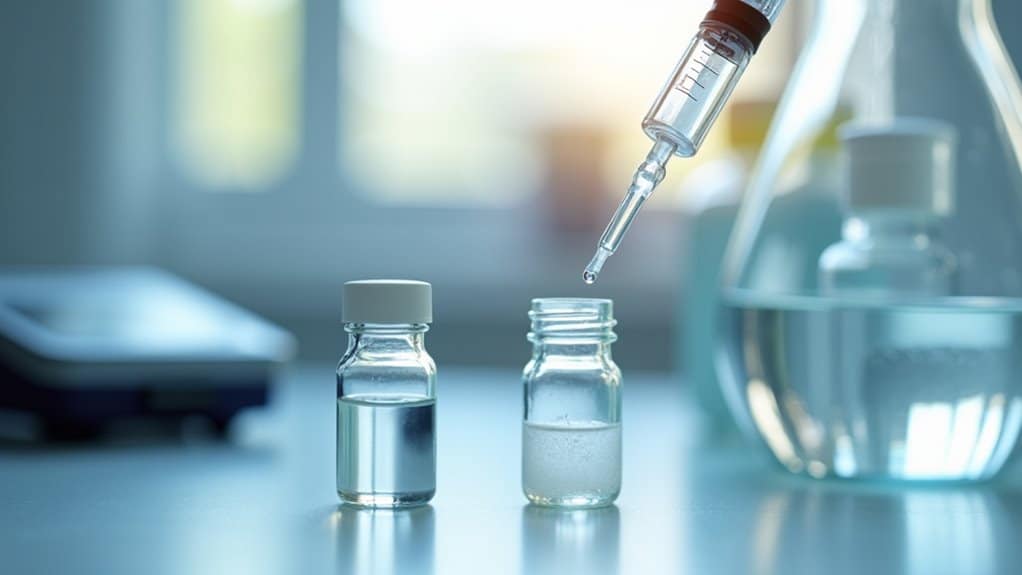
Concentration is calculated by dividing total peptide amount by reconstitution volume. When you enter the vial’s peptide content in milligrams, concentration is read as mg/mL. Enter 10 mg of peptide reconstituted in 1 mL of bacteriostatic water, and you get 10 mg/mL. If your vial content is measured in micrograms, the same relationship holds, producing a mcg/mL result after unit conversion.
This calculation tells you exactly how much active peptide ends up in each milliliter of solution. That figure drives every downstream step, including your draw volume and syringe-unit conversion, so precision here matters. Double-check both inputs before you rely on the output, since an error in either mass or volume shifts your concentration and every dose you measure afterward.
How do you set diluent volume for a target concentration
Set diluent volume by dividing peptide mass by your target concentration, then add exactly that amount of bacteriostatic water to the vial.
Say a 10 mg vial and a 5 mg/mL target:
Say a 5 mg vial and a target of 2.5 mg/mL solution:
- Mass: 10 mg is your fixed vial content.
- Target concentration: 5 mg/mL is your desired ratio.
- Diluent volume: 10 ÷ 5 = 2 mL of water to add.
Choose a target concentration that keeps draw volumes measurable on your U-100 syringe. Many calculators suggest preset volumes like 1, 2, or 3 mL to hit common concentrations reliably.
What worked reconstitution examples help
Worked reconstitution examples help you convert vial strength, diluent volume, and target dose into the exact volume to draw. Start simple: dissolve 10 mg of peptide in 1 mL of bacteriostatic water, and you get a 10 mg/mL concentration. Need a 1 mg dose? Divide target by concentration, 1 mg ÷ 10 mg/mL equals 0.1 mL. On a U-100 insulin syringe, multiply by 100, so you draw 10 units.
Microgram targets follow the same logic. A 250 mcg dose from a 2.5 mg/mL solution equals 0.1 mL, again 10 units. A Bio-Techne example shows 2 mcg at 10 mcg/mL yields 0.2 mL, or 200 microliters.
Run your own numbers this way, and each draw is confirmed before it reaches the vial.
What common reconstitution calculation mistakes to avoid
The most common reconstitution calculation mistakes are mixing units, confusing mL with syringe units, and ignoring the actual solvent volume added. Small unit slips and misreadings compound fast, and the syringe won’t warn you.
Guard against these three common mistakes:
- Mixing units. Entering peptide mass in milligrams but reading your target dose in micrograms breaks the formula. Convert everything to one unit before dividing (1 mg = 1,000 mcg).
- Confusing mL and syringe units. Remember U-100 syringes give 100 units per mL, so a 0.1 mL draw equals 10 units, not 100.
- Ignoring solvent volume. Concentration depends on the water you actually add, using the vial’s total capacity instead of your measured volume skews every result.
Double-check inputs before you draw.
Order Lab-Verified Peptides for Every Calculation
Converting mg to mcg or calculating reconstitution volumes, verified peptide purity ensures accurate research outcomes. Every batch at Holas is backed by independent lab results for verified purity and batch consistency. Browse our full catalog or reach out to discuss your sourcing needs.
Frequently Asked Questions
How Long Does Reconstituted Peptide Stay Stable in the Refrigerator?
Reconstituted research peptides are generally stable for a few weeks refrigerated at 2 to 8°C, though the exact window varies by compound, concentration, and solvent. Bacteriostatic water’s benzyl alcohol limits microbial growth in multi-use vials but does not stop chemical degradation such as hydrolysis, oxidation, and aggregation. The supplier’s stability documentation for the specific peptide is the definitive reference, and solutions showing cloudiness, discoloration, or particulates are discarded.
What Type of Water Should I Use for Reconstitution?
Bacteriostatic water is the standard solvent for reconstitution, listed among the typical calculator inputs alongside peptide mass and target amount. It contains a small amount of benzyl alcohol, which helps limit microbial growth in multi-use vials. Once the chosen solvent volume is added, commonly 1 mL, 2 mL, or 3 mL, the calculator uses that amount to determine concentration and draw volume accurately.
Can I Freeze Reconstituted Peptides for Longer Storage?
Yes, reconstituted peptides can be frozen to extend storage, typically at −20°C for shorter periods or −80°C for longer ones, ideally in single-use aliquots to avoid repeated freeze-thaw cycles that degrade peptide integrity. The concentration math is unaffected by storage: concentration, target-amount draw volume, and insulin-syringe unit conversions stay the same. The supplier’s product documentation gives the specific freezing and stability guidance for a given peptide.
What Syringe Size Is Best for Small Peptide Volumes?
A U-100 insulin-style syringe suits small measured volumes, reading in units where 1 mL equals 100 units, which gives fine precision, for example drawing 0.1 mL as 10 units. For very small amounts, a lower-capacity syringe (30 or 50 units) maximizes accuracy. Matching the syringe size to the calculated draw volume, and confirming the concentration before measuring, avoids measurement errors.
How Do I Properly Store Lyophilized Peptides Before Reconstitution?
Lyophilized peptides are best stored in a freezer at −20°C or colder, sealed and protected from light and moisture. Minimizing temperature fluctuations and avoiding repeated freeze-thaw cycles helps, and keeping desiccant nearby controls humidity. Letting vials reach room temperature before opening prevents condensation. For long-term storage, −80°C is ideal, and the supplier’s guidance is the reference since stability varies by peptide sequence.