Lyophilized peptides are more chemically stable than peptides in solution, but they are not inert. Residual moisture, oxygen, light, and temperature drive deamidation, oxidation, cleavage, beta-elimination, and aggregation in the solid state. Storage below −20 °C, dry, sealed, and dark, slows those pathways enough to support multi-year usable life. The step most often gotten wrong is not storage at all: it is opening a cold vial before it has equilibrated, which condenses water onto the cake and undoes the protection lyophilization provided.
Key Takeaways
- Lyophilization removes bulk water, which slows hydrolysis and reduces molecular mobility, extending usable life from weeks in solution to years as a dry solid.
- Degradation continues in the solid state through deamidation, oxidation, cleavage, beta-elimination, Maillard reactions, and aggregation, at much slower rates.
- Let cold vials reach room temperature in a desiccator before opening. Condensation on a cold cake introduces the water lyophilization removed.
- Store below −20 °C, dry, sealed, and light-protected. Lower temperature helps mainly by reducing molecular mobility.
- Sequence determines liability. Met, Trp, Tyr, His, and free Cys are oxidation-prone; Asn and Gln are deamidation sites.
What happens when you open a cold vial
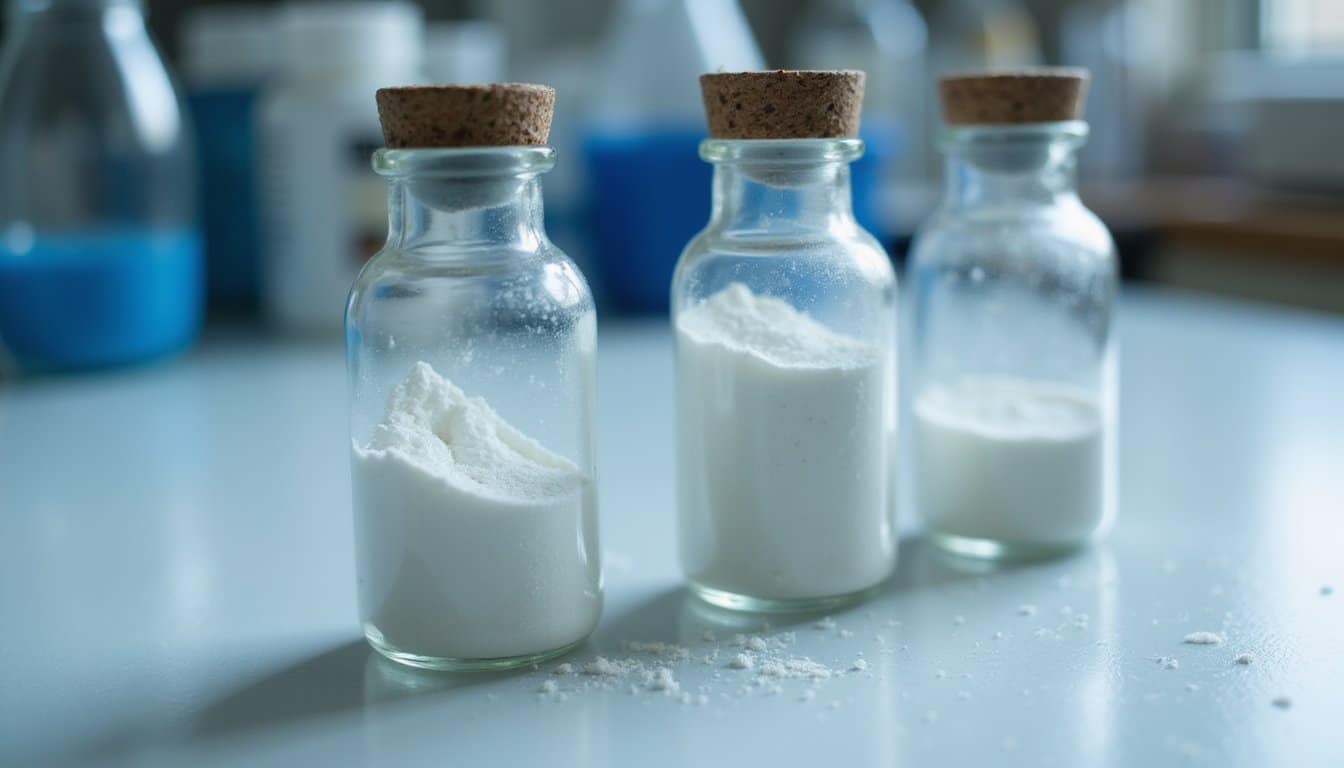
A vial taken from a −20 °C freezer and opened immediately is colder than the surrounding room’s dew point, allowing moisture to condense on the vial, stopper, and peptide cake. This can reduce lyophilized peptide stability by locally rehydrating material that was carefully dried during lyophilization, even when the vial is otherwise handled correctly.
This matters more than it sounds. Water in a lyophilized cake does not simply sit there. It plasticizes the amorphous matrix, lowering the glass transition temperature and increasing molecular mobility. Mobility is what the whole strategy was suppressing. Deamidation, cleavage, and aggregation all accelerate once the solid is soft enough for the reacting groups to find each other.
The damage is also cumulative and silent. A vial opened cold once, weighed, and returned to the freezer looks identical. Repeat that across a study and the cake has taken on moisture with each cycle, with no visible change and no obvious point of failure. The material simply performs less consistently over time, and the cause is not in any record.
The handling that prevents it is unglamorous:
- Equilibrate before opening. Let the vial reach room temperature in a closed desiccator before the stopper comes off. The time this takes depends on vial size and starting temperature, but it is not optional.
- Aliquot on first opening. The most effective control on freeze-thaw and condensation cycles is to have fewer of them. Split the material once, under good conditions, and work from aliquots.
- Reseal against a dry headspace. An opened vial resealed in humid room air now stores its own moisture supply.
- Log the cycles. If a lot behaves inconsistently, handling history is the first thing worth having and the thing least often recorded.
What chemical degradation pathways affect peptides
Six pathways account for most solid-state degradation, and which of them applies is a property of the sequence rather than of peptides in general.
Deamidation at Asn and Gln converts a neutral side chain into a charged one, shifting purity and charge profile. It is water-sensitive and accelerates with residual moisture and pH excursions.
Oxidation affects Met, Trp, Tyr, His, and free Cys. Oxygen, light, and trace metals all promote it. This is the pathway that inert-gas overlay and amber vials are aimed at.
Peptide bond cleavage occurs preferentially near labile residues, with Asp-containing sequences particularly prone under acidic conditions.
Beta-elimination at susceptible residues is favored by alkaline microenvironments.
Maillard reactions between free amines and reducing sugars are a formulation question rather than a sequence one. It is the reason reducing sugars are avoided as excipients.
Aggregation and dimerization, covalent or not, can occur in the solid state and often only reveals itself on reconstitution as incomplete dissolution or cloudiness.
The practical implication is that sequence chemistry can help define the right peptide storage conditions in advance. Met-containing sequences carry oxidation risk, Asn can undergo deamidation, and free Cys may oxidize or form dimers. Reading the sequence helps identify which storage controls matter most for a specific compound rather than applying every general recommendation.
Which liabilities apply to common research peptides
Some general patterns across compound classes commonly held in research collections:
GHRH analogs. The native GHRH 1-29 sequence and its analogs contain methionine, which makes oxidation the pathway to watch. Oxygen exclusion and light protection matter more for these than for sequences without a susceptible residue.
GHK-Cu. The copper center is the complicating factor. Copper is redox-active, and metal-catalyzed oxidation is a recognized pathway for copper-containing peptides. Handling that treats GHK-Cu as chemically equivalent to an uncomplexed tripeptide misses this.
Cysteine-containing sequences. Free thiols oxidize and form disulfide-linked dimers in the solid state. For these, aggregation and oxidation are the same problem viewed from two angles, and both are oxygen-driven.
Long, hydrophobic sequences. High hydrophobic content raises aggregation propensity independent of any specific reactive residue, and the failure often presents at reconstitution rather than during storage.
The point is not to memorize a table. It is that “store cold and dry” is generic advice, and knowing which residue in a given compound is actually at risk tells you which control to prioritize when you cannot have all of them.
What factors accelerate peptide degradation
| Accelerant | Main risk | Control |
|---|---|---|
| Residual moisture | Plasticizes cake, raises mobility, drives deamidation and cleavage | Desiccant, sealed closure, equilibrate before opening |
| Temperature | Raises reaction rates and molecular mobility | Store ≤ −20 °C, minimize excursions |
| Oxygen | Oxidation of Met, Trp, Tyr, His, Cys | Inert gas overlay, low-oxygen packaging |
| Light | Photolysis, accelerated oxidation | Amber vials or dark storage |
| Solid-state form | Amorphous matrices react faster than crystalline | Control drying, avoid collapse |
Two of these interact in a way worth naming. Temperature and moisture are not independent controls. A cake with higher residual water has a lower glass transition temperature, which means the same freezer temperature provides less protection than it would for a well-dried cake. Cold does not compensate for wet.
And a dry appearance is not dryness. Residual water in an amorphous cake is not visible, and a cake that looks intact can carry enough moisture to have lost most of the mobility advantage lyophilization bought.
How do you test chemical stability of lyophilized material
Stability is assessed by placing representative vials under defined conditions and measuring degradation with methods capable of separating degradants from the parent peptide. In addition to stability assessments, it is crucial to analyze the impact of degradation products on formulation performance. When considering how to make dsip nasal spray, one must ensure that the final product maintains its efficacy and safety throughout its intended shelf life.
- Set the conditions. Typically −20 °C and −80 °C for long-term, plus accelerated temperatures to force pathways that would take years to appear otherwise, with light, oxygen, and humidity controlled and recorded.
- Pull at intervals. Record appearance, cake integrity, residual moisture, and reconstitution behavior at each timepoint. Cake collapse and slow dissolution are early signals that precede measurable chemical change.
- Quantify. HPLC and LC-MS for purity, identity, and degradant profile. SEC for aggregation and dimerization, which reversed-phase methods can miss. Peptide mapping where cleavage site matters.
- Run stressed samples. Deliberately degraded material proves the method can actually see the degradants. A method that shows nothing on a stressed sample shows nothing on a real one either, and the clean chromatogram means the opposite of what it appears to mean.
- Check mass balance. Purity falling without a corresponding degradant peak appearing means something is not being detected.
The stressed-sample step is the one most often skipped and the one that determines whether any of the other data means anything.
What protective strategies improve stability
Protection follows from the dominant pathway rather than from a generic checklist.
Temperature. Store below −20 °C, with −80 °C for material intended to sit for years. The benefit is mobility suppression, which is why the gain is largest for amorphous cakes and for sequences with mobility-dependent pathways like deamidation.
Moisture. Validated drying, tight container closure, desiccant, and disciplined handling. The equilibration step covered above is the single highest-yield habit here, because it addresses the moisture ingress that the packaging cannot.
Oxygen. Inert gas overlay and low-oxygen packaging for sequences carrying Met, Trp, or free Cys. Degassed diluent at reconstitution for the same sequences. For compounds without an oxidation-prone residue, this effort is largely wasted and better spent on moisture control.
Light. Amber vials or dark storage. Cheap, and it costs nothing to apply universally.
pH and excipients. Worth treating carefully. Acidic conditions suppress some pathways and accelerate others, since Asp-containing sequences cleave faster at low pH. There is no universally protective pH, only one that is right for a given sequence. Reducing sugars are avoided outright, since they supply the Maillard partner.
What shelf life can you expect for lyophilized peptides
Well-dried, sealed, light-protected lyophilized peptide commonly remains usable for several years at −20 °C, and reported stability at −80 °C extends considerably longer. Those figures assume the conditions held, which is the part that varies. Tfa-acetate counterion analysis is crucial for ensuring the stability of the stored peptides under varying conditions. Understanding the role of counterions can help in optimizing storage protocols for better long-term preservation.
Three things determine whether a stated shelf life describes your vial:
- Handling history, not calendar age. A vial opened cold four times at eighteen months is in worse condition than an unopened vial at three years. The date on the label tracks time, not treatment.
- Sequence. A peptide with no Met, no Asn, and no free Cys has fewer available pathways than one with all three, and generic shelf-life figures average across both.
- Actual storage record. Excursions matter and are usually unrecorded. A freezer that failed over a weekend leaves no trace on the vial.
Once reconstituted, the clock restarts under entirely different chemistry. Hydrolysis resumes, the sequence-specific pathways accelerate, and stability in solution is measured against buffer, temperature, and sequence rather than against any general figure. Solution stability is its own question and should be established for the specific compound and conditions rather than assumed from a number.
Conclusion
Lyophilization buys years by taking water out of a system where water is the principal reactant. Almost everything that goes wrong afterward involves putting some of it back, and the most common way that happens is not a failed freezer or a broken seal. It is a cold vial opened in a warm room.
The rest follows from reading the sequence. Met means oxidation, so oxygen exclusion earns its cost. Asn means deamidation, so moisture control matters most. Free Cys means both oxidation and dimerization. Absent those residues, effort spent on inert gas is effort not spent on the desiccator. Generic advice to store cold and dry is correct and tells you nothing about which control to prioritize when resources are finite.
And a vial’s condition is a function of how it was handled, not how long it has existed. Equilibrate before opening, aliquot on first entry, keep the cycles few and recorded, and the material will behave the way its stability data says it should.
Shop Research Peptides at Holas Today
If you are looking for research peptides that are properly handled, securely packaged, and shipped with care, Holas has you covered. We provide laboratory-grade peptides with third-party tested purity, reliable packaging standards, and fast shipping to support your research needs. Browse our full catalog or contact us to source the right peptides for your protocol.
Frequently Asked Questions
Why should a cold vial be equilibrated before opening?
A vial straight from the freezer is below the dew point of room air, so moisture condenses on the vial and the cake when the stopper comes off. That water plasticizes the amorphous matrix, raises molecular mobility, and accelerates deamidation, cleavage, and aggregation. Let the vial reach room temperature, closed, in a desiccator, before opening.
Are lyophilized peptides chemically inert?
No. Lyophilization removes bulk water, which slows hydrolysis substantially, but solid-state degradation continues through deamidation, oxidation, cleavage, beta-elimination, Maillard reactions, and aggregation. The rates are much slower, not zero.
What temperature should lyophilized peptides be stored at?
Below −20 °C for general storage, with −80 °C for material intended to sit for years. The mechanism is mobility suppression rather than temperature itself, which is why a wetter cake gains less from the same freezer than a well-dried one does.
Which residues carry the most stability risk?
Met, Trp, Tyr, His, and free Cys are oxidation-prone. Asn and Gln are deamidation sites. Free Cys additionally forms disulfide-linked dimers. Sequences high in hydrophobic content carry aggregation risk independent of any specific reactive residue.
Can a cake look fine and still be compromised?
Yes. Residual water in an amorphous cake is not visible, and a cake that appears intact can carry enough moisture to have lost most of its mobility advantage. Appearance is a useful early signal for collapse and dissolution problems, not evidence of dryness.
Why do stability studies include deliberately stressed samples?
To prove the analytical method can detect the degradants. A method that shows nothing on stressed material would also show nothing on genuinely degraded material, so a clean chromatogram from an unvalidated method means the opposite of what it appears to mean.
Does the expiry date reflect the condition of a specific vial?
Only partly. Handling history matters more than calendar age. A vial opened cold several times at eighteen months can be in worse condition than an unopened vial at three years, and freezer excursions leave no visible trace.
Lyophilized Peptide Stability Change During Repeated Freeze-Thaw Cycles?
Yes. Repeated freeze-thaw exposure can increase moisture uptake, aggregation, and chemical degradation, even in lyophilized material. For best stability, researchers generally minimize cycles and divide material into smaller aliquots, aiming for no more than 1 to 2 freeze-thaw events whenever possible.
Why Are Peptide Bonds Stable While Side Chains Can Still Degrade?
Peptide bonds are relatively resistant under normal storage conditions, but amino acid side chains can undergo oxidation, deamidation, or hydrolysis. Residues such as methionine, cysteine, asparagine, and glutamine are often more vulnerable, with degradation rates increasing significantly as temperature and humidity rise.
Are Peptides Stable After a Short Power Outage?
Often, yes, if the outage is brief and the vial remains cold and dry. A lyophilized peptide stored at 2°C to 8°C may tolerate several hours of temperature drift better than a reconstituted peptide, but prolonged warming above 20°C to 25°C can accelerate degradation.
Lyophilized Peptide Storage Require Humidity Monitoring?
Yes, humidity control is important because lyophilized peptides readily absorb moisture after exposure to air. Keeping relative humidity below about 30% to 40% during handling and storing vials tightly sealed with desiccant can help preserve stability.