You’ll secure custom peptides in 2-3 weeks for standard sequences under 30 amino acids at 95% purity, but expect 3-5 weeks for industry standards or 1-2 weeks extra for complex sequences and 98% purity needing intense HPLC chromatography. Fmoc-SPPS automates synthesis on solid supports, slashing cycles to days with real-time monitoring, while rigorous QC, LC-MS, MALDI-TOF, endotoxin tests, guarantees 98%+ success rates and detailed COAs. Understanding turnaround time and quality control in custom peptide production boosts efficiency in your research. You’ll secure custom peptides in 2, 3 weeks for standard sequences under 30 amino acids at 95% purity, but expect 3, 5 weeks for industry standards or 1, 2 extra weeks for complex sequences and 98% purity requiring intensive HPLC chromatography. Fmoc-SPPS automates synthesis on solid supports, reducing cycles to days with real-time monitoring, while rigorous QC, LC-MS, MALDI-TOF, and endotoxin testing, ensures 98%+ success rates and detailed COAs.Understanding turnaround time and quality control in custom peptide production helps researchers avoid common peptide ordering mistakes, improving planning and ensuring reliable materials for laboratory experiments.
Industry Standard Peptide Turnarounds
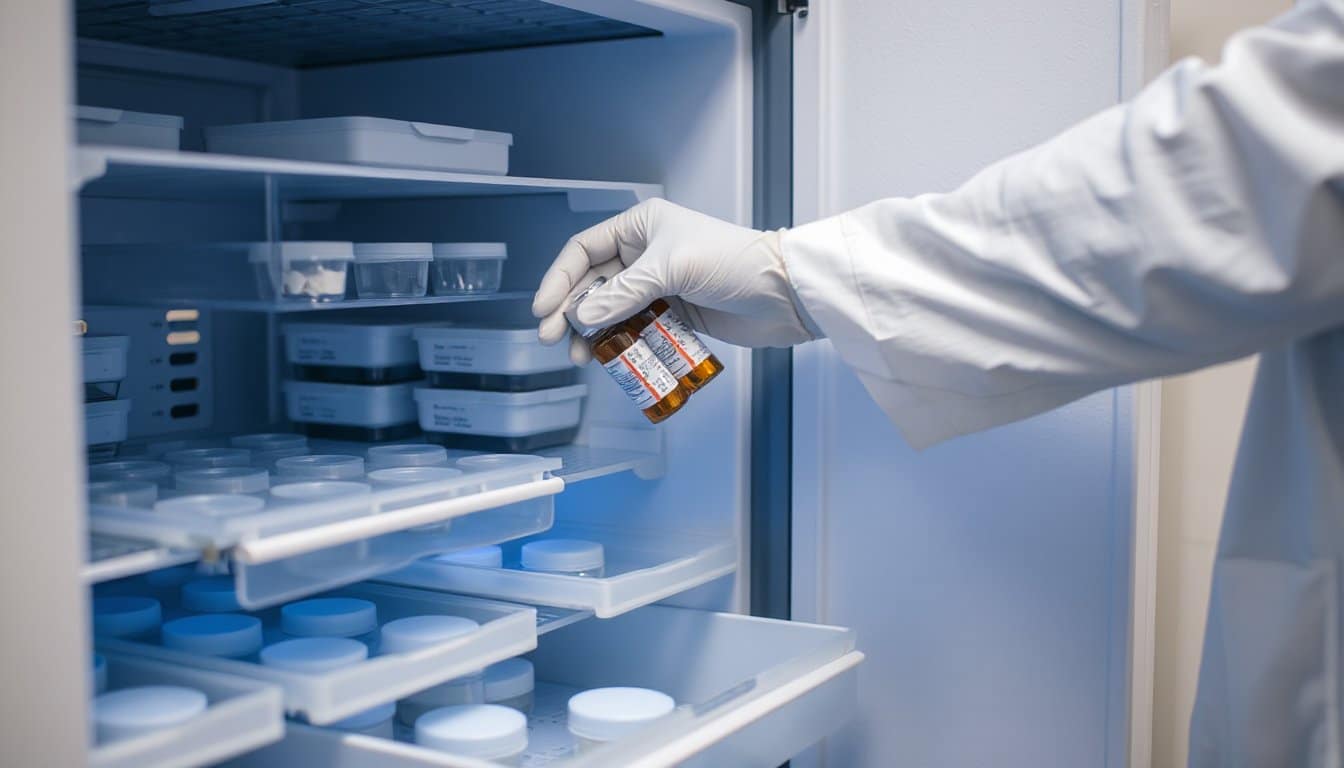
While industry standard turnaround times for custom peptide synthesis typically range from 3, 5 weeks, most providers deliver standard peptides under 30 amino acids in 2, 3 weeks. Your custom peptide turnaround time depends on sequence complexity impact, peptide order lead time, and requested purity levels. Standard peptide production schedule assumes basic modifications; complex sequences requiring optimization extend timelines considerably. High-purity lead times (≥95%) typically add 1, 2 weeks compared to crude preparations. Many providers offer Fmoc solid-phase technology for efficient synthesis across scales from 0.1 mg to over 1 kg. Sarchem Laboratories Inc. provides custom peptide synthesis services from its location in Farmingdale, NJ, USA. o2h Discovery offers ultra-fast synthesis in 2 weeks with a guarantee. Analytical queue time for HPLC and mass spectrometry confirms identity and purity, essential quality checkpoints before shipment. Purification time and RP-HPLC timelines vary by peptide characteristics, hydrophobic sequences demand extended processing. Re-purification timelines increase costs and delivery duration when initial purification doesn’t meet specifications. Shipping adds overnight delivery within North America or 3, 4 days internationally, separate from synthesis completion.
Purity Levels vs Delivery Timelines
High-purity peptides demand extended delivery timelines due to intensified purification and quality control steps. You’ll encounter difficult peptide lead times and modification lead times with 98% purity peptides or higher, as they require multiple chromatography runs, identity confirmation lc-ms, and analytical hplc purity report to guarantee purity acceptance criteria. 95% purity peptides ship faster, often within standard 2-3 weeks, since they bypass exhaustive re-purification. You uphold compliance through batch release criteria, including impurity profiling for truncated sequences and counterions, which delays shipping dispatch timing for 99% grades. Balance your needs, 95% purity peptides suit routine assays, but opt for 98% purity peptides when precision outweighs speed in sensitive applications.
Solid-Phase Tech Speeds Peptide Delivery
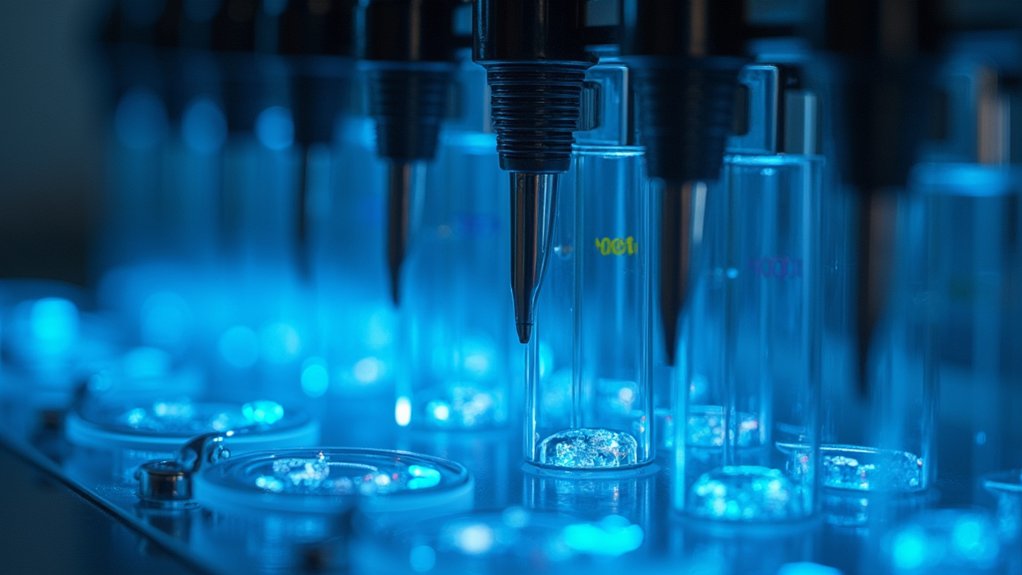
Solid-phase peptide synthesis (SPPS) accelerates your custom peptide delivery through high automation and streamlined workflows. Automated synthesizers complete amino acid linkages via preset programs, dramatically reducing synthesis cycles from weeks to days or hours. You’ll benefit from synthesis optimization through real-time monitoring that adjusts deprotection and coupling times for complete conversions. The solid support eliminates intermediate separations, impurities wash away during each cycle, streamlining final purification. Your yield recovery strategies improve considerably since excess reagents drive reactions to completion while minimizing sequence errors. Integrated QC checkpoints using MALDI-TOF and chromatogram interpretation validate identity and purity against your specification sheet. The COA release workflow and lot release testing confirm delivered material matches requested specifications, supporting predictable scheduling across multi-lab collaborations where timing and reproducibility matter. In addition to these enhancements, the applications of peptide synthesis in labs are continually expanding, offering innovative solutions for drug development and research. As the demand for customized peptides grows, the integration of advanced automation technologies will further enhance efficiency and scalability in various therapeutic areas. Researchers are now able to explore complex peptide structures and optimize their functional properties with unprecedented speed and accuracy.
QC Guarantees 98%+ Success Rates
Rigorous quality control guarantees you receive custom peptides with 98%+ success rates, as providers validate identity and purity via LC-MS, MALDI-TOF, HPLC, and detailed COAs before release. You benefit from extensive documentation package timing that aligns with your research context, ensuring predictable packaging timeline and labeling verification RUO. Providers perform contamination screening, endotoxin testing, moisture content checks, peptide content assay, and counterion verification to meet specifications. These steps, part of a final quality assurance review, address QC challenges like contamination and high costs, supporting reproducible outcomes in biologics research and multi-lab collaborations. Standardized methods confirm material integrity, bolstering peptide therapeutics’ 23-26% trial success rates. Rigorous quality control guarantees you receive custom peptides with 98%+ success rates, as providers validate identity and purity via LC-MS, MALDI-TOF, HPLC, and detailed COAs before release. Understanding what is peptide synthesis helps clarify why these verification steps are essential for confirming sequence accuracy and purity in laboratory-produced peptides. You benefit from an extensive documentation package that aligns with your research context, ensuring predictable packaging timelines and RUO labeling verification.Providers perform contamination screening, endotoxin testing, moisture content checks, peptide content assays, and counterion verification to meet specifications. These steps, part of a final quality assurance review, address QC challenges like contamination and high costs, supporting reproducible outcomes in biologics research and multi-lab collaborations. Standardized methods confirm material integrity, bolstering peptide therapeutics’ 23, 26% trial success rates.
How Fast Peptides Boost Research Efficiency

Accelerated synthesis technologies speed up your custom peptide production, enabling research efficiency with automatic synthesizers handling up to 192 sequences via microwave-assisted Fmoc-SPPS that’s 10 times faster than conventional methods. Boc-SPPS tackles your long peptides over 50 residues in hours, while ultraviolet monitoring cuts failed cycles during feasibility review time and customer approval steps. You streamline chain-of-custody steps, batch records, and deviation handling for rapid iteration, factoring in rush order constraints, cold-pack planning, and lab planning considerations. BPC-157 accelerates your tissue repair sevenfold by day three; CJC-1295 boosts IGF-1 1.5, 3x for muscular recovery. These gains, via enhanced angiogenesis, mitochondrial efficiency, and reduced inflammation, extend your endurance, cut downtime, and propel experiments forward through optimized corrective action process.
Shop Research Peptides at Holas Today
If you are looking for research peptides that are properly handled, securely packaged, and shipped with care, Holas has you covered. We provide laboratory-grade peptides with third-party tested purity, reliable packaging standards, and fast shipping to support your research needs. Browse our full catalog or contact us to find the right peptides for you today.
Frequently Asked Questions
What Are Peptide Synthesis Costs?
You’ll find peptide synthesis costs vary dramatically by supplier, purity level, and quantity. Crude peptides start at $2.00, $16.05 depending on final mass, while purified options range from $6.10, $79.18. Per-residue pricing runs $1.98, $4.50. High-purity peptides (>95%) cost vastly more. Modifications like acetylation, phosphorylation, and D-amino acids incur additional charges. Most suppliers impose $100, $200 minimum orders, and HPLC/MS analysis adds costs for crude peptides.
How to Order Custom Peptides?
Submit your peptide sequence, specifications, quantity, purity, and modifications via the online quote request form. You’ll receive a formal price quote and technical support. Provide a PO or pay by credit card through the secure portal. After sequence analysis confirmation, we synthesize using Fmoc solid-phase methods with QC via MS and HPLC. Expect lyophilized delivery in 10 business days to 2-3 weeks.
What Payment Methods Accepted?
You accept major credit and debit cards via high-risk processors like QuadraPay and SanctusPay, plus ACH transfers, eChecks (1-5 business days in USD), PayPal, cryptocurrencies, e-wallets, and bank transfers. Global options support USD, EUR, GBP, CAD, AUD for researchers worldwide. You’re offered fraud protection, chargeback alerts, and instant processing during secure checkout.