You lyophilize peptides to remove water that degrades them, creating stable powders you store for years at -20°C or below and ship ambiently without losing biological activity. Rapid freezing at -40°C forms small ice crystals, preventing aggregation; primary drying sublimes 95% unbound water below collapse temperature, while secondary drying desorbs bound moisture at +20, 30°C. Lyoprotectants like trehalose form glassy matrices for integrity. This process is essential to lyophilization in peptide manufacturing, and you’ll explore stages, excipients, and challenges ahead.
Why Lyophilize Peptides for Stability?
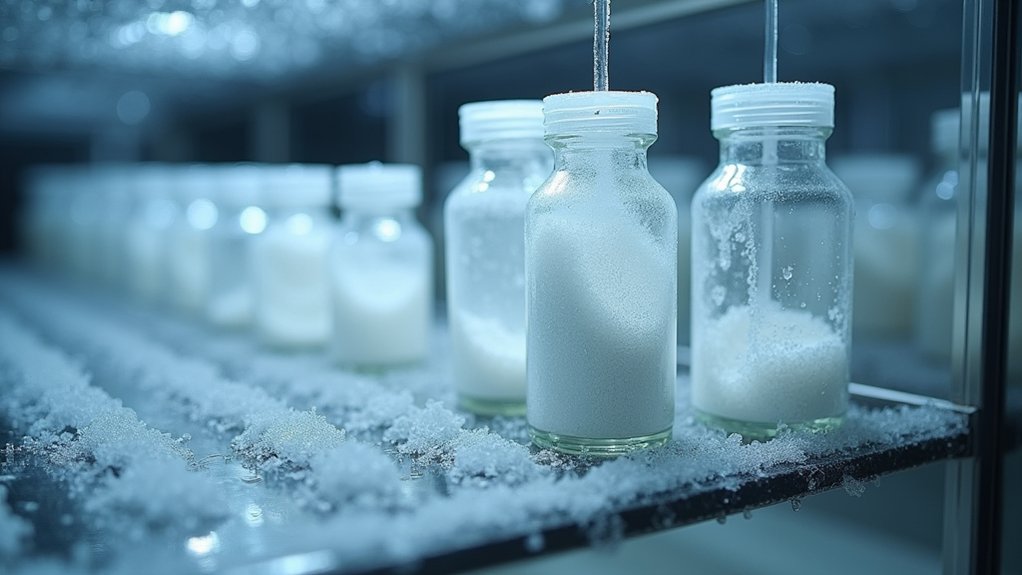
You’ll prevent contamination through dry, inert sealing, often with argon purging to block oxidation. Lyoprotectants like trehalose and mannitol form a glassy matrix that minimizes molecular mobility, reduces aggregation, and enhances biological activity via higher Tg′ formulations. This extends shelf life for years at, 20 °C or below, enables ambient shipping, and simplifies handling by tolerating short-term temperature exposures without potency loss. Lyophilization removes water to preserve peptide integrity and convert them into stable powders. Most peptides are manufactured and stored in lyophilized form rather than in solution, which ensures superior long-term stability compared to liquid alternatives.
What Is Peptide Lyophilization?
During primary drying, you maintain shelf temperatures at -40°C to -20°C, sublimating 95% of unbound water over hours until ice vanishes and pressure stabilizes. In secondary drying, you raise temperatures to +20°C to +30°C for desorption of bound water, yielding a dry, free-flowing “lyo cake” under <3% moisture.
You vent the chamber with nitrogen, stopper vials under vacuum, and seal to block humidity, ensuring long-term stability for your research peptides.
Freezing Stage in Peptide Lyophilization
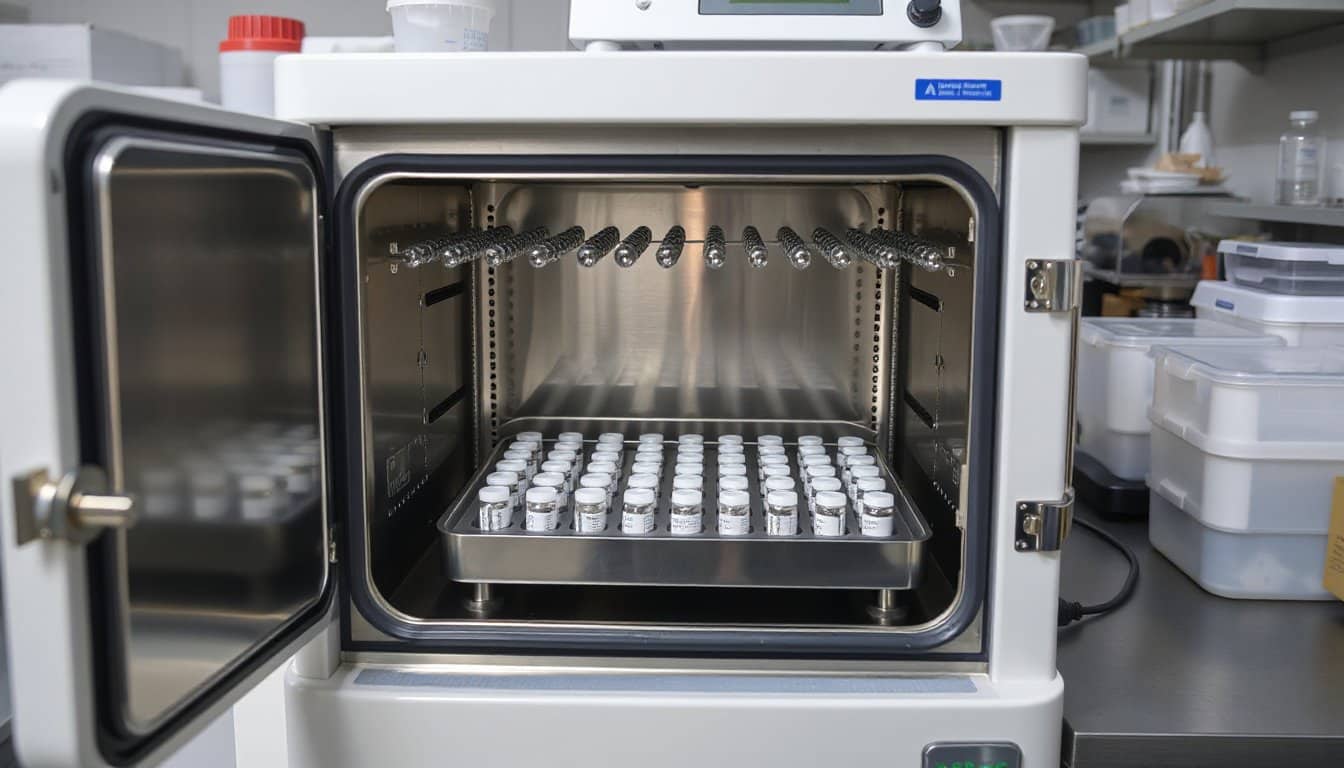
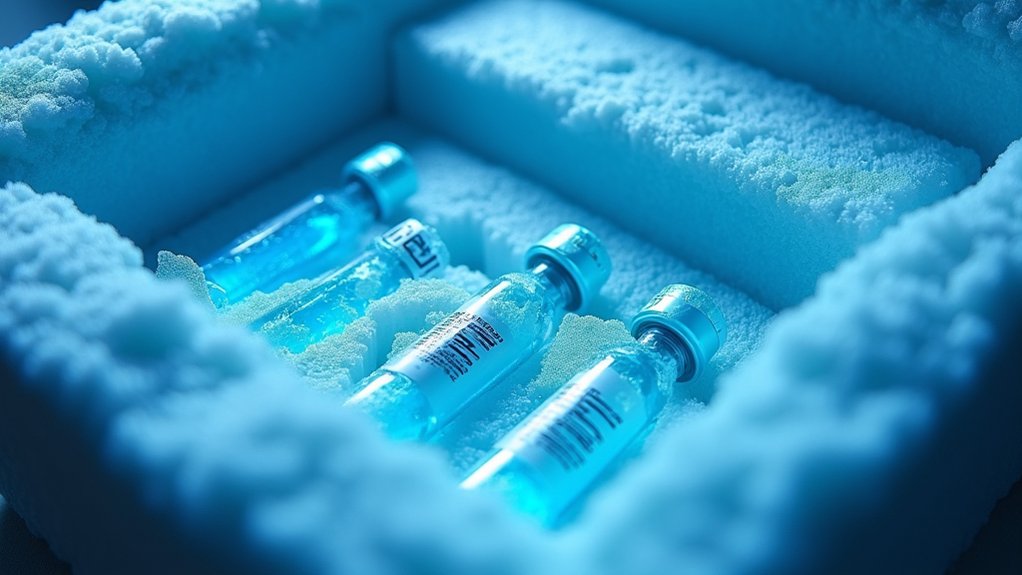
You use rapid freezing methods like liquid nitrogen or dry ice/ethanol baths to solidify peptide solutions at around -40°C or lower, achieving snap-freezing within minutes for ideal preservation. This produces small, uniform ice crystals that form a stable frozen matrix, unlike slow freezing at -20°C which creates larger crystals and risks aggregation or inefficient sublimation. You’ll maintain samples below the eutectic point until lyophilization to guarantee structural integrity and efficient water removal.
Rapid Freezing Methods
Because rapid freezing is critical to forming smaller ice crystals and preventing peptide degradation, several methods can achieve the controlled solidification needed before the drying stage begins. You use a dry-ice/ethanol bath for snap-freezing peptide solutions or liquid nitrogen for rapid aliquot solidification, targeting temperatures well below the freezing point to enable efficient sublimation and hydrolysis prevention. Alternatively, employ a, 80 °C ultralow freezer overnight or plate-based freezers like RoSS.pFTU for uniform, automated control at lab scales, avoiding, 20 °C due to slow cooling risks that heighten oxidation sensitivity. For speed advantages, nanolitre droplet atomisation leverages high surface-to-volume ratios. Select clean 2 mL cryotubes or glass serum vials, submerge fully for opaque solidification, and handle gently to safeguard reproducibility before drying.
Ice Crystal Formation
- Freezing rate influences crystal characteristics, slower cooling produces larger crystals that create more porous matrices, facilitating subsequent sublimation
- Peptides undergo dynamic conformational adaptation at ice surfaces, optimizing hydrogen bonding with the lattice structure
- Product temperature must remain below collapse temperature to prevent structural failure and maintain stable ice-crystal matrices
Controlled nucleation techniques, including ice fog and pressure drop methods, ensure uniform crystal distribution across vials, protecting your peptide’s structural integrity throughout the freezing stage.
Primary Drying for Peptide Powders
You control sublimation process in primary drying by pulling vacuum to 0.1 mbar or 0.01 Torr while raising shelf temperature gradually to, 40 °C to, 20 °C, keeping product temperature below its collapse point to remove 95% of unbound water as vapor. This targeted control facilitates efficient ice-to-gas conversion without melt-back, forming a stable, porous peptide matrix over several hours. You achieve peptide cake formation as a fluffy, intact powder when pressure stabilizes, no ice remains visible, and the structure supports reconstitution.
Sublimation Process Control
Apply a deep vacuum of 0.1 mbar or 0.01 Torr to initiate sublimation in the primary drying phase, enabling ice to convert directly to vapor without a liquid phase. You establish vacuum before adjusting shelf temperature control, raising shelves gradually to, 40 °C to, 20 °C while keeping product temperature below the collapse temperature. Monitor chamber pressure with Pirani or capacitance manometers; stabilization signals completion.
- Rapid freezing at, 80 °C creates small ice crystals for efficient sublimation and uniform matrix, shortening drying time.
- Track sublimation monitoring via frost on condenser, vial ice absence, and product sensors to guarantee endpoint accuracy.
- Achieve >90% water removal, preventing cake collapse and enabling overnight cycles for peptide powders.
Peptide Cake Formation
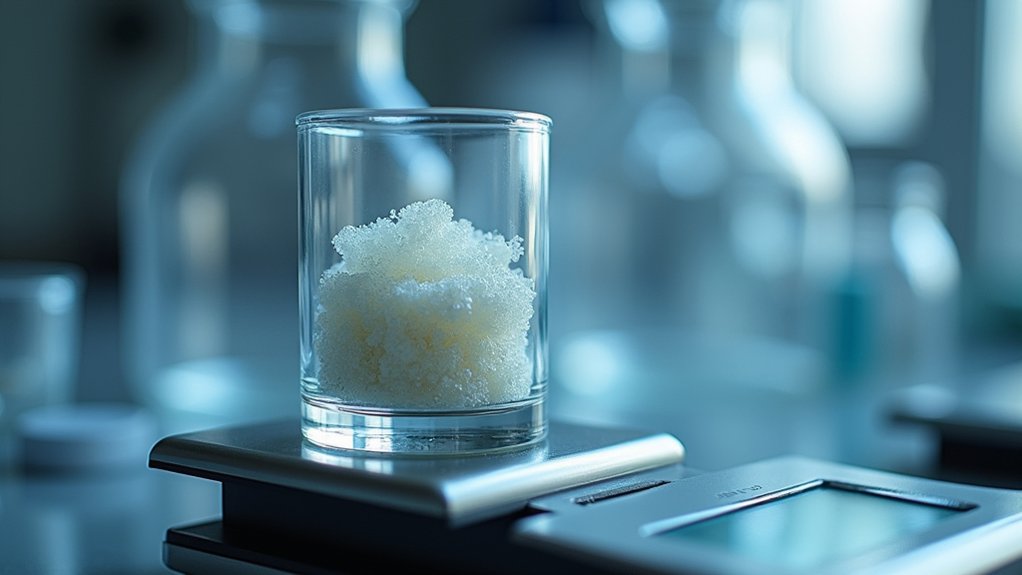
Peptide cake formation occurs during primary drying, where you maintain product temperature below the collapse point, typically via shelf temperatures of -40°C to -20°C under 10-100 mTorr vacuum, to sublimate ice and form a stable, porous structure. This process removes 80, 95% of water while preserving peptide integrity. You’ll know sublimation is complete when visible ice disappears and chamber pressure stabilizes, typically within hours to overnight depending on solution volume. The resulting freeze-dried reagent format exhibits uniform, dry, white or off-white cake appearance, signaling successful lyophilization. Discoloration or clumping indicates degradation or process failure. Controlled nucleation techniques minimize ice crystal size, reducing primary drying time by 30% while improving homogeneous cake appearance and quality indicators. Low ramping rates of 0.1, 1°C/min maintain structural integrity throughout this critical phase.
Secondary Drying: Removing Bound Moisture

- Optimize time for large volumes or high concentrations, sampling sub-lots at multiple points to monitor desorption kinetics.
- Monitor heat flux changes, as vial coefficients shift from primary drying, requiring experimental validation.
- Ensure vacuum integrity to avoid residual moisture risks, minimizing energy-intensive process time while aiding regulatory compliance.
Essential Equipment for Peptide Lyophilization
You select freeze-dryer systems like Telstar’s LyoAlfa -85 or Optima Pharma’s LYO series to achieve GMP-compliant lyophilization of pharmaceutical peptides, ensuring precise temperature control down to -85°C and efficient moisture removal. Pair these with vacuum pumps, such as 2-stage rotary vane models that generate vacuums below 0.003 mbar, to accelerate drying while maintaining batch repeatability. Equip your setup with condensers featuring -85°C capacities and AISI 316L construction to capture solvents without ice blockages, optimizing peptide stability.
Freeze-Dryer Systems
Three essential subsystems guarantee reliable operation:
- Low-temperature shelves paired with condenser units cooled well below shelf temperature to capture water vapor efficiently
- Vacuum pump capabilities producing pressures below 0.003 mbar for ideal sublimation rates
- Heat flux measurement technology and nucleation detection for non-invasive process monitoring
These integrated components allow you to achieve reproducible, high-quality lyophilized peptides while maintaining structural integrity and biological activity. When considering new suppliers, it’s essential to watch for potential red flags in peptide purchases. Ensuring transparency in sourcing and laboratory practices can help identify quality products. Always verify certifications and review customer feedback to minimize risks associated with these critical materials.
Vacuum Pumps
In integration in process, you activate the pump after placing frozen vials on the shelf, pulling vacuum to start primary drying, then continue through secondary drying at heightened temperatures up to 20 mbar. You vent with inert gas post-drying, stopper under vacuum, and change fresh oil before each run to prevent contamination and guarantee residual moisture below 1, 2%.
Condensers
Consider these essential aspects:
- Temperature control performance: Condensers reach -50 to -85°C, creating pressure gradients that drive vapor from product to condenser surfaces. Deeper temperatures optimize solvent removal and accelerate sublimation rates.
- Capacity configuration options: Laboratory systems range from 0.5L to 50L condenser capacities, with condensing rates from 0.5L to 40L per 24 hours. Manifold designs accommodate diverse flask types simultaneously without chamber constraints.
- Maintenance efficiency: Smooth-walled designs eliminate ice blockages and enable faster defrost cycles compared to traditional coil alternatives, reducing turnaround between batches.
Top Excipients for Peptide Cake Stability
Top excipients like mannitol, trehalose, glycine, sucrose, and hydroxyethyl starch enhance peptide cake stability in lyophilized formulations by forming protective matrices that prevent aggregation and ice crystal damage during freeze-drying. You select mannitol as a bulking agent for its visible cake structure, though its crystallization reduces long-term stability. Trehalose creates a glassy matrix, delivering superior storage stability improvements and solubility after lyophilization for peptides like glucagon. Glycine acts as a cryoprotectant, supporting pH stability but risking turbidity and unfolding alone. Sucrose bolsters glassy-state protection against aggregation, while hydroxyethyl starch offers high Tg (>200°C) yet permits unfolding and degradation. Balance these based on your protocols to optimize cake integrity and peptide preservation.
Reconstituting Lyophilized Peptides
- Select solvents precisely: Use sterile water for neutral pH peptides, bacteriostatic water for injections, or PBS/NaCl for isotonic needs; apply dilute acetic acid for hydrophobic ones per datasheets (pH 4, 8).
- Add solvent gently: Dispense slowly down the vial wall at an angle to avoid foaming, shear stress, or denaturation.
- Mix and verify: Swirl intermittently for 2, 30 minutes, let sit 15, 30 minutes; troubleshoot insolubility with DMSO or sonication, then document via HPLC.
Address reconstitution considerations in research framing and stability documentation to preserve quality.
Key Challenges in Peptide Lyophilization
| Challenge Category | Key Issues | Impacts |
|---|---|---|
| Uniformity | Edge-vial effect, stochastic nucleation | Inconsistent morphology, batch variability |
| Scale-Up | Nucleation shifts, choked flow | High failure risk, extended trials |
| Process Control | Temperature/pressure precision | Collapse, degradation, rejection |
| Cost/Efficiency | Long cycles, energy use | Reduced throughput, high costs |
| Regulatory | Contamination, validation | Sterility risks, compliance hurdles |
You tackle moisture control packaging to boost shelf life of research peptides, but scale-up demands controlled nucleation and real-time monitoring for reproducibility. You tackle moisture control packaging to boost shelf life of research peptides, but scale-up demands controlled nucleation and real-time monitoring for reproducibility an approach that strengthens peptide quality control by ensuring consistent stability, handling, and batch performance during production and storage. Choosing a reliable peptide supplier is crucial to maintain high standards and ensure the integrity of your research outcomes. Such partnerships enable access to quality materials and innovative techniques that can further enhance your production processes. By prioritizing supplier reliability, you lay the groundwork for successful scale-up and sustainability in peptide research.
Why Lyophilization Powers Peptide Drugs
- Enhance stability: Block degradation pathways, maintaining activity under GMP-validated conditions.
- Cut logistics costs: Reduce cold chain needs, enabling room-temperature handling with minimal loss.
- Boost regulatory compliance: Meet FDA/EMA shelf-life standards for scalable production.
Shop Research Peptides at Holas Today
If you are looking for research peptides that are properly handled, securely packaged, and shipped with care, Holas has you covered. We provide laboratory-grade peptides with third-party tested purity, reliable packaging standards, and fast shipping to support your research needs. Browse our full catalog or contact us to find the right peptides for you today.
Frequently Asked Questions
How Long Does a Typical Lyophilization Cycle Take From Freezing to Final Product?
You complete a typical lyophilization cycle for peptides in 12-72 hours from freezing to final product. You freeze rapidly at -80°C for hours, then run primary drying at -40°C to -20°C for several hours to overnight, followed by secondary drying at 20-40°C for 3-12 hours. Unoptimized cycles extend to days or 240 hours, but you shorten them via controlled nucleation and annealing.
What Is the Difference Between Cryoprotectants and Bulking Agents in Peptide Formulations?
You use cryoprotectants to shield peptides from freezing and drying stresses during lyophilization. They remain amorphous, form hydrogen bonds replacing water, and raise glass conversion temperature (Tg’) for vitrification and molecular stability. You add bulking agents like mannitol or glycine for mechanical strength and elegant cake structure. They crystallize, create porous scaffolds for sublimation, and prevent collapse while enabling high fill weights.
Can Lyophilized Peptides Be Shipped at Room Temperature, and for How Long?
Yes, you can ship lyophilized peptides at room temperature for short transits of 1-3 days if you use well-sealed packaging with desiccants, protecting from heat, moisture, and light. Stability lasts weeks to months at ambient temperatures, but prolonged exposure risks degradation from humidity or sequence-specific factors. For longer shipments, add cold packs or dry ice; store at 2-8°C post-arrival.
What Residual Moisture Content Is Acceptable in Freeze-Dried Peptide Products?
You accept 0.5-5% residual moisture in freeze-dried peptide products, targeting 3-5% for room temperature or refrigerated stability and <1-3% for ideal long-term preservation. You achieve <1% via secondary drying at 35-55°C, but avoid overdrying, which harms protein stability. You monitor via Karl Fischer titration, balancing moisture to prevent hydrolysis while maintaining cake integrity.
How Should Lyophilized Peptide Cakes Be Stored to Maintain Long-Term Stability?
Store lyophilized peptide cakes at , 20°C in airtight borosilicate glass vials with PTFE-lined screw-caps or crimp-tops, flushed with inert gas and including desiccants. You protect them from light using amber/opaque containers, avoid frost-free freezers and freeze-thaw cycles by aliquoting, and warm sealed vials to room temperature in a desiccator before opening to prevent condensation.