You guarantee peptide production reliability through batch testing, which performs exhaustive quality control on each lot, verifying identity via LC-MS and MS/MS, purity ≥95% by HPLC or LCMS, and potency by amino acid analysis. You also check physical properties like water content, solubility, stability, and endotoxin levels via LAL for safety. Unlike single checks, it analyzes multiple samples for uniformity, lot-to-lot consistency, and regulatory compliance like FDA rules. Explore core techniques and orthogonal tests next. You guarantee peptide production reliability through batch testing, which performs exhaustive quality control on each lot, verifying identity via LC-MS and MS/MS, purity ≥95% by HPLC or LCMS, and potency by amino acid analysis. These verification steps are often complemented by hpic peptide analysis to further evaluate separation performance and impurity profiles during laboratory testing.You also check physical properties like water content, solubility, stability, and endotoxin levels via LAL for safety. Unlike single checks, batch testing analyzes multiple samples for uniformity, lot-to-lot consistency, and regulatory compliance such as FDA guidelines. Explore core techniques and orthogonal tests next. You guarantee peptide production reliability through batch testing, which performs exhaustive quality control on each lot, verifying identity via LC-MS and MS/MS, purity ≥95% by HPLC or LCMS, and potency by amino acid analysis. You also check physical properties like water content, solubility, stability, and endotoxin levels via LAL for safety. Unlike single checks, it analyzes multiple samples for uniformity, lot-to-lot consistency, and regulatory compliance such as FDA rules. These validation practices are essential when evaluating peptide suppliers for research, since reliable manufacturers must demonstrate consistent QC documentation and analytical verification. Explore core techniques and orthogonal tests next.You guarantee peptide production reliability through batch testing, which performs exhaustive quality control on each lot, verifying identity via LC-MS and MS/MS, purity ≥95% by HPLC or LCMS, and potency by amino acid analysis. These verification steps are often complemented by HPIC peptide analysis to further evaluate separation performance and impurity profiles during laboratory testing. You also check physical properties like water content, solubility, stability, and endotoxin levels via LAL for safety. Unlike single checks, batch testing analyzes multiple samples for uniformity, lot-to-lot consistency, and regulatory compliance such as FDA guidelines. Explore core techniques and orthogonal tests next.
What Is Peptide Batch Testing?
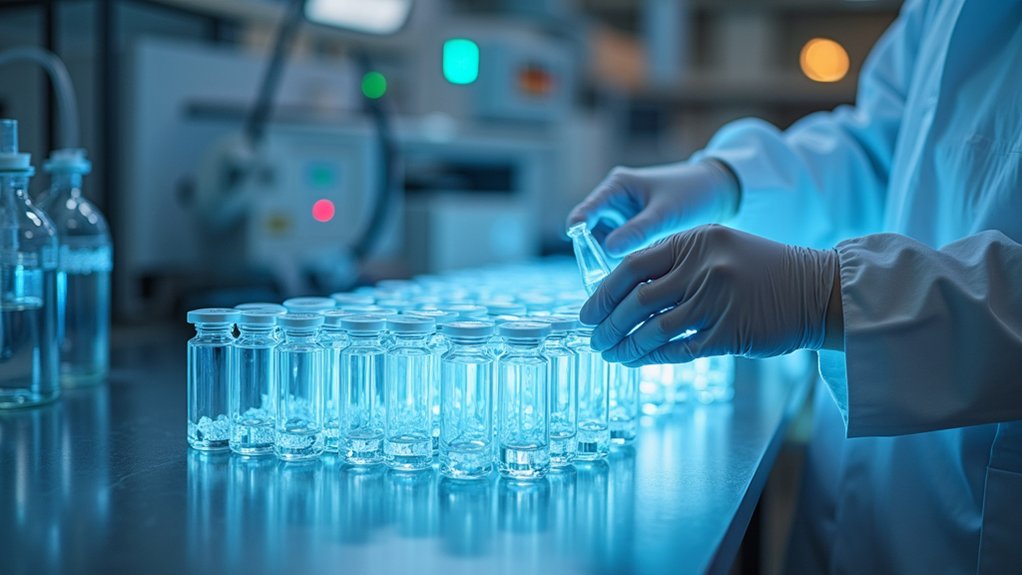
Peptide batch testing performs exhaustive quality control on each production lot of peptides before you use them, verifying that identity, purity, and other metrics meet predefined specifications. You’ll rely on this batch release testing peptides and final product testing to catch inconsistencies early, ensuring peptides behave predictably in your experiments. Analytical HPLC batch release at 214 nm quantifies purity specifications, typically ≥95%, while mass spectrometry confirms molecular weight and sequence against acceptance criteria. Multiple orthogonal analytical techniques, including NMR, peptide mapping, and amino acid analysis, are used to establish identity and evaluate modifications, ensuring comprehensive characterization of each batch. Reliable vendors provide batch-specific COAs documenting these tests with verifiable laboratory details. You’ll review batch records and Certificates of Analysis for traceability, linking outcomes to the intended molecule. This surpasses single-sample testing by sampling multiple vials, safeguarding reproducibility across assays. Batch-to-batch consistency is vital to maintain stable biological activity.
Key Metrics for Peptide Batch Quality
You’ll evaluate key metrics for peptide batch quality through identity verification, purity assessment, potency determination, physical properties, and safety compliance to guarantee consistent performance. In peptide batch testing, you use lc-ms identity release with HR-MS or MS/MS to match observed molecular weights against theoretical fingerprints, ensuring sequence accuracy via ESI-QTof systems. For purity assessment, HPLC or LCMS quantifies ≥95% thresholds, detecting impurities that disrupt assays; qc checkpoints flag variability. You determine potency via AAA for net content (±10%) and counterion levels. Verify water via Karl Fisher, solubility, stability monitoring, and enantiomeric purity for physical properties. LAL testing confirms endotoxin safety. In-process controls enable lot traceability, linking to FDA-compliant release. You’ll evaluate key metrics for peptide batch quality through identity verification, purity assessment, potency determination, physical properties, and safety compliance to guarantee consistent performance. In peptide batch testing, you use LC-MS identity release with HR-MS or MS/MS to match observed molecular weights against theoretical fingerprints, ensuring sequence accuracy via ESI-QTof systems.For purity assessment, HPLC or LCMS quantifies ≥95% thresholds, detecting impurities that disrupt assays while QC checkpoints flag variability. You determine potency via amino acid analysis (AAA) for net content (±10%) and counterion levels. Verify water content via Karl Fischer titration, assess solubility and stability monitoring, and confirm enantiomeric purity for physical property validation. Proper handling methods, including lyophilization peptides, also support long-term stability before analytical testing. LAL testing confirms endotoxin safety, and in-process controls enable lot traceability, linking results to FDA-compliant release standards.
Why Batch Testing Beats Single Checks
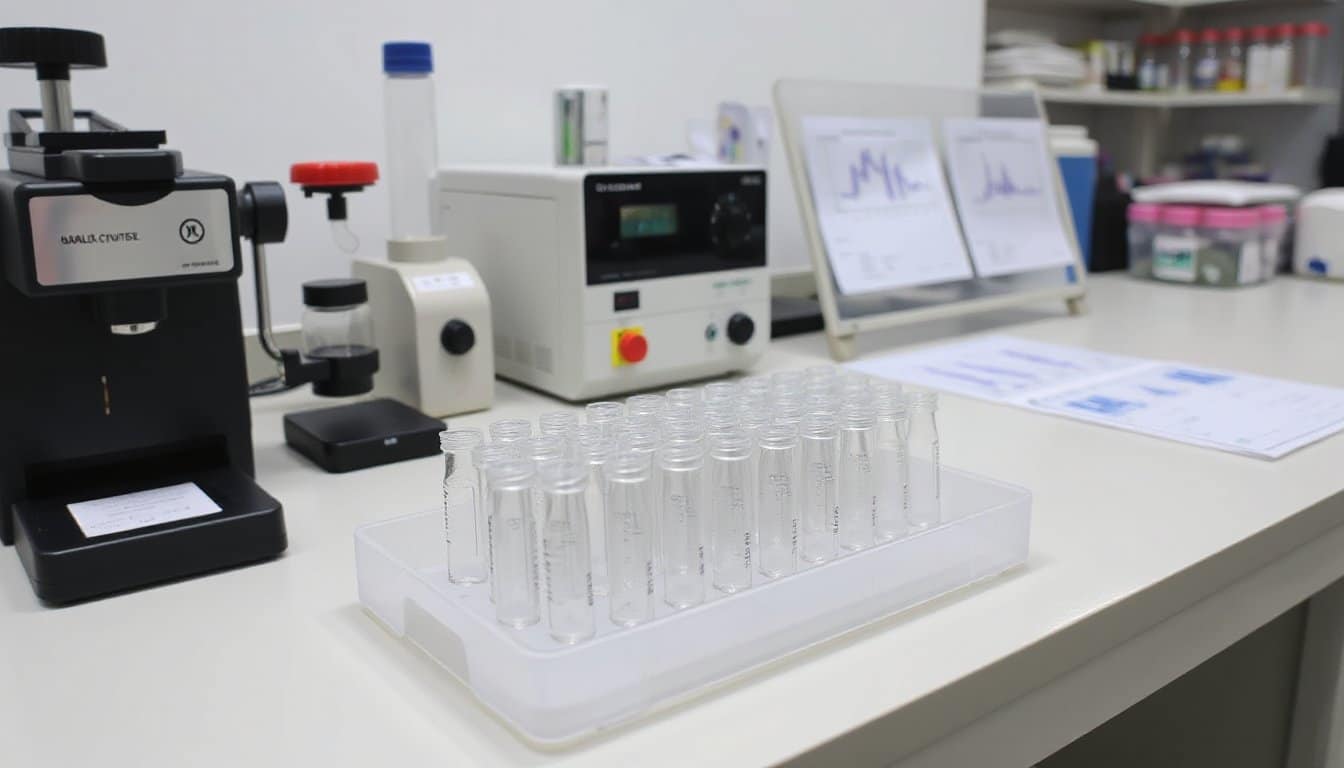
Batch testing surpasses single checks by analyzing multiple samples from a production lot, verifying uniformity in identity, purity, and potency across the entire batch while catching container-to-container variations that one vial might miss. You’ll gain reproducibility assurance as batch testing delivers lot-to-lot consistency, ensuring stable biological activity so your experiments link outcomes to the intended molecule, not aberrations. It detects inconsistencies early through contamination controls, confirming every vial meets standards and preventing wasted resources from undetected impurities. In QA in peptide production, batch testing fulfills regulatory compliance by meeting pharmaceutical mandates for each lot’s release, supplying documented proof for grants or therapeutics. Unlike single checks’ risks of divergent results, this approach minimizes research variability for reliable datasets.
HPLC, MS, and AAA: Core Testing Methods
- Implement deviation management and corrective actions if peaks deviate from standards.
- Enforce change control and sample retention for reproducibility across batches.
- Conduct documentation review and data package review to validate results.
Orthogonal Tests and Regulatory Rules

Orthogonal tests complement core methods like HPLC, MS, and AAA by employing distinct separation principles to confirm peptide identity, purity, and impurity profiles with greater confidence. You integrate these into your quality management system alongside supplier qualification and process validation to guarantee manufacturing controls align with regulatory rules. For instance, PEC achieves 86% purity for Histone H3 (1-20) in one step, outperforming RP chromatography, while combining PEC with RP-HPLC maximizes yields and cuts solvent waste by 85%. Mass detection verifies insulin peak purity; immunogenicity assays like PANDA screen risks orthogonally. Maintain chain-of-custody documentation and risk management through LC-MS/MS stability tests and 2D LC for impurities, building FDA-compliant biosimilar data packages.
Shop Research Peptides at Holas Today
If you are looking for research peptides that are properly handled, securely packaged, and shipped with care, Holas has you covered. We provide laboratory-grade peptides with third-party tested purity, reliable packaging standards, and fast shipping to support your research needs. Browse our full catalog or contact us to find the right peptides for you today.
Frequently Asked Questions
How Much Does Batch Testing Cost?
You’ll pay $200-$800 per batch for research institutions‘ analytical testing to verify identity, purity, and stability via HPLC ($150-$250) and mass spectrometry ($100-$200). Add $25-$75 for a Certificate of Analysis, or $75-$125 for endotoxin tests. Factors like peptide complexity, scale, and GMP compliance raise costs; bulk discounts cut 15-30%.
How Long Does Batch Testing Take?
Batch testing duration depends on peptide complexity, length, and solubility. You’ll complete raw material testing first, verifying amino acids and solvents before synthesis begins. During synthesis, you’ll monitor sequence accuracy in real time through in-process testing. Final validation requires HPLC for purity assessment and mass spectrometry for molecular weight verification. Comprehensive multi-sample analysis guarantees uniformity across your production lot, with total timelines varying from days to weeks depending on peptide difficulty.
What if a Batch Fails Testing?
When your batch fails testing, you’ll trigger an immediate investigation protocol. You must hold the batch pending resolution and determine whether the failure stems from laboratory error, process deviations, or material quality issues. If investigation confirms the batch doesn’t meet purity specifications, you’ll either re-purify it or discard it entirely. You’ll document all findings and implement corrective actions to prevent recurrence, ensuring regulatory compliance before any release.
How to Store Tested Peptide Batches?
Store tested peptide batches lyophilized at -80°C for maximum stability exceeding 6 months or -20°C for 1-6 months; use -15°C as minimum. Refrigerate reconstituted solutions at 4°C for up to 30 days in pH 5-7 buffers, aliquoting to avoid freeze-thaw cycles. Protect with desiccants, dark conditions, inert gas, and tight seals from moisture, light, and air.