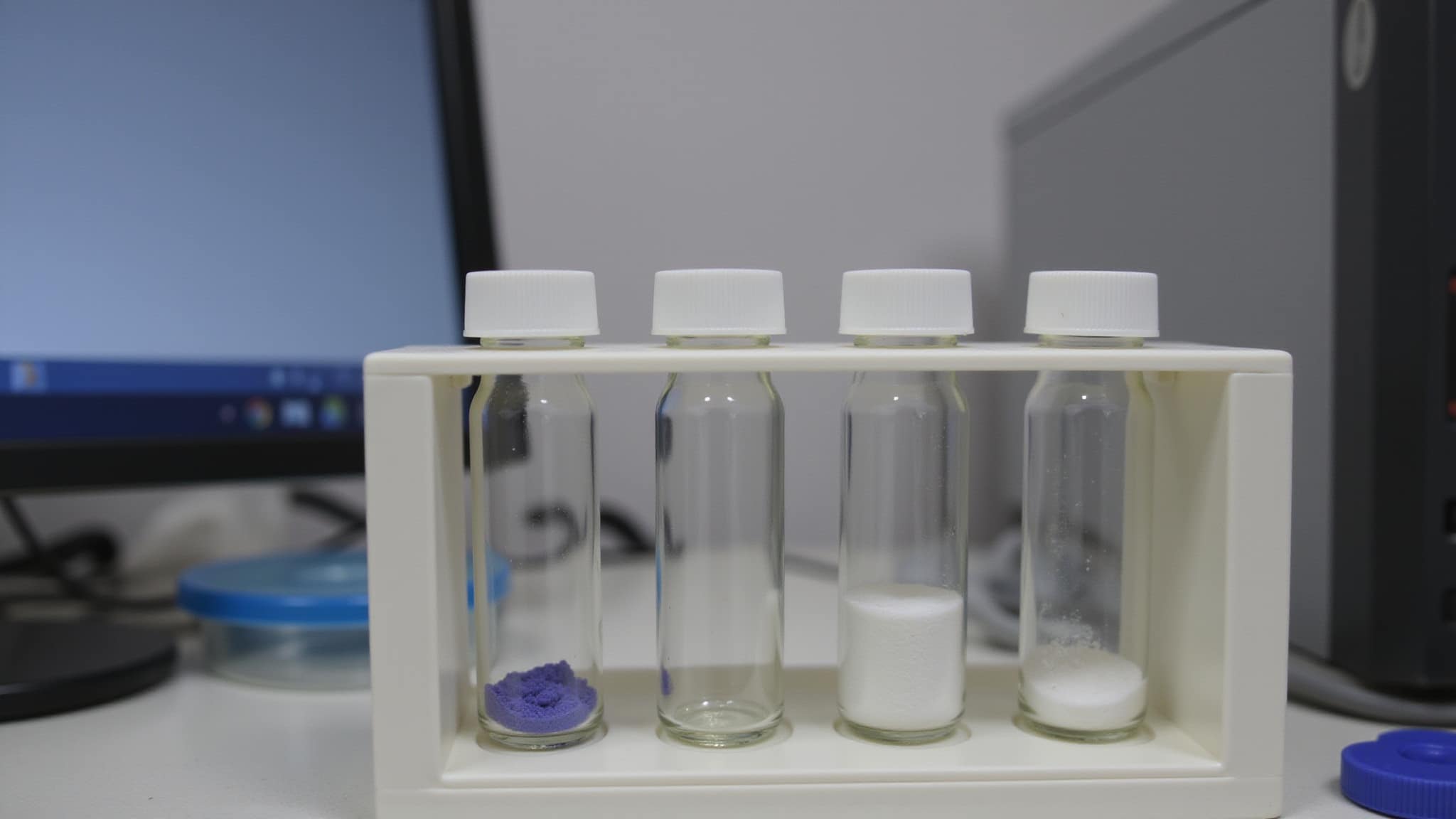
Thymosin beta-4 is a 43-residue actin-sequestering protein studied for its role in extracellular matrix remodeling. It has been reported to modulate MMP activity, influence collagen organization, and support the migration of keratinocytes, fibroblasts, and endothelial cells through provisional matrix. TB-500 is a synthetic fragment derived from this protein, not the protein itself, and the distinction matters because most of the mechanistic literature describes full-length Tβ4. This page covers what that literature reports and where the fragment’s evidence base diverges from it.
Key Takeaways
- Thymosin beta-4 is a 43-residue protein with a documented actin-sequestering function; TB-500 is a shorter synthetic fragment of it.
- Most published ECM remodeling mechanisms describe full-length Tβ4, and fragment activity should not be assumed identical.
- Reported Tβ4 effects include modulation of MMP-1, MMP-2, and MMP-9, alongside influence on collagen organization and fibronectin turnover.
- Reported effects are context-dependent, with MMP induction described in some tissue models and suppression in others.
- Ac-SDKP, a cleavage product of Tβ4, carries its own reported anti-fibrotic activity and is a separate entity from either the parent protein or the fragment.
What is thymosin beta-4, and what is TB-500

Thymosin beta-4 is a small, highly conserved protein of 43 amino acids, present in most cell types and abundant in platelets and wound fluid. Its best-characterized function is sequestering monomeric G-actin, which buffers the pool available for filament assembly and gives cells control over where and when they build cytoskeletal structure. Nearly everything else attributed to Tβ4 in the ECM literature runs downstream of that. How thymosin beta-4 sequesters actin is crucial for cellular dynamics. By regulating actin availability, thymosin beta-4 influences processes such as cell migration and tissue repair.
TB-500 is a synthetic peptide derived from this protein. It reproduces a portion of the sequence, centered on the actin-binding region, rather than the whole molecule.
The distinction is not a formality, and it is worth being direct about why:
- The literature is mostly about the protein. The MMP induction data, the signaling pathway work, the fibrosis models: these overwhelmingly used full-length Tβ4. Citing them for a fragment is an inference, not a finding.
- A fragment reproduces some functions, not necessarily all. The actin-binding motif is short and a fragment containing it can retain actin interaction. Functions requiring regions outside that motif are a separate question, and the answer is not automatic.
- Nomenclature makes this easy to miss. TB-500 is commonly described as thymosin beta-4 in vendor and forum material. It is derived from it. The two words are doing different work.
Everything below describes what has been reported for Tβ4 unless stated otherwise. Where a mechanism has been characterized specifically for a fragment, that is a narrower and generally thinner body of evidence, and it is the question worth asking of any claim made about TB-500 on mechanistic grounds.
What is the extracellular matrix
The extracellular matrix is a network of collagen, fibronectin, laminin, proteoglycans, and bound growth factors. It provides mechanical structure, and it also functions as a signaling substrate that cells read through integrin engagement.
Four properties matter for how any matrix-active compound is studied:
- It is an anchor. Cells adhere to it, and adhesion strength and geometry determine whether they can move.
- It transmits tension. Cells sense substrate stiffness and orient their cytoskeleton accordingly, which is where actin regulation intersects with matrix biology.
- It stores signals. Growth factors bind matrix components and are released by proteolysis, so degradation is itself a signaling event rather than only a clearance one.
- It has architecture. Fiber orientation and ligand density carry directional information, not just structural load.
The relevance to Tβ4 is that a compound regulating actin dynamics is acting on the cell’s ability to read and respond to all four. That is an indirect route to matrix remodeling, and it is the reason Tβ4 effects appear across so many different endpoints.
What ECM changes have been characterized during repair

Matrix repair has been described as a sequence of states rather than a single process, and Tβ4 research intersects with different stages differently.
Provisional matrix. Fibrin, fibronectin, plasma proteins, and hydrated glycosaminoglycans form a soft, permissive scaffold with low tensile strength. This is the phase where cell migration is possible and where actin regulation is most relevant. Thymosin beta-4 and corneal epithelial migration play crucial roles in the healing process. These factors contribute to the regeneration of the corneal surface, enhancing overall ocular health.
Proteolytic clearance. Proteases cleave damaged collagen, denatured basement membrane, and matrix fragments. This is where MMP modulation enters, and where the balance point sits: too little proteolysis and the scaffold obstructs, too much and the structural and signaling cues dissolve.
Deposition. Fibroblasts lay down type III collagen, proteoglycans, and fibronectin, while capillaries invade the matrix-rich bed.
Maturation. Collagen crosslinks, type III is replaced by type I, basement membrane reassembles, and fibers align along tension lines. The matrix becomes denser, less cellular, and mechanically stronger. Excess deposition at this stage produces stiff, disorganized tissue rather than organized tissue.
These stages overlap rather than proceed cleanly, which is one reason single-timepoint measurements of matrix-active compounds are difficult to interpret.
What mechanisms have been reported for Tβ4

Actin sequestration. The mechanism with the strongest support. Tβ4 binds G-actin and buffers the monomer pool, which affects how cells extend, contract, and migrate. This is the function most plausibly retained by a fragment containing the binding motif.
MMP modulation. Tβ4 has been reported to raise MMP-1, MMP-2, and MMP-9 expression in several repair-relevant cell types. The reported effect is not uniform: different cell types show different MMP patterns, and the direction is context-dependent, with induction described in some tissue models and suppression in others. A mechanism that reverses sign between models is a mechanism whose conditions are not fully mapped.
Signaling pathway modulation. Reported interactions span PI3K/Akt, Notch, NF-κB, Toll-like receptor signaling, TGF-β, and Wnt. This is a broad list, and breadth is worth reading skeptically rather than as evidence of potency. A protein reported to touch six major pathways is either a genuine hub or the subject of a literature that has looked in many places.
Ac-SDKP. Tβ4 is cleaved to release Ac-SDKP, a tetrapeptide with its own reported anti-fibrotic activity, described in relation to myofibroblast conversion and CTGF signaling. This deserves separating out: effects attributed to Tβ4 that actually run through Ac-SDKP are effects of a cleavage product, and whether a given fragment yields it is a distinct question.
Why the fragment question matters for interpretation
Reading the mechanisms above, the pattern is that they belong to different parts of the molecule and different levels of evidence.
Actin sequestration is a motif-level function. A fragment carrying the binding region has a plausible claim to it, and this is the mechanism most often cited for TB-500 with reason.
MMP modulation and pathway signaling are attributed to full-length Tβ4 in the source literature. Whether a fragment reproduces them depends on whether the responsible regions are present, and on whether the effects are direct or downstream of actin regulation. If downstream, a fragment retaining actin binding might reproduce them. If direct, it might not. The literature does not settle this cleanly.
Ac-SDKP activity is a cleavage-product function and separate from both.
The practical consequence is that a mechanistic claim about TB-500 should be traceable to one of three sources: work on the fragment itself, work on Tβ4 with a stated reason the fragment should behave the same, or an inference. All three appear in circulation, and only the first two are evidence.
How are these mechanisms studied
The endpoints used to investigate matrix effects each answer a narrow question, which is worth knowing when reading a claim built on any one of them.
- Migration assays report whether cells move, which is the readout closest to the actin mechanism and the most directly interpretable.
- Zymography and MMP expression report protease activity or transcript level, not matrix outcome. An MMP increase is a step in an argument, not the conclusion.
- Collagen synthesis assays report deposition, which can rise from more cells, more output per cell, or reduced degradation. These are distinguished by orthogonal measurement, not by the assay itself.
- Tube formation reports endothelial network assembly, which correlates with angiogenic capacity without demonstrating vessel formation.
- Fibrosis models report tissue-level architecture, which is furthest from mechanism and hardest to attribute to a single pathway.
No single endpoint establishes a matrix-remodeling mechanism. Convergence across several, in the same system, with the same preparation, is what supports attribution, and it is rarer in this literature than the volume of citation suggests.
Conclusion
The thymosin beta-4 literature describes a plausible and internally coherent picture: a protein that buffers actin monomers, thereby shaping how cells migrate through and remodel provisional matrix, with reported downstream effects on protease activity, collagen organization, and fibrotic conversion. The actin mechanism is well supported. The rest is a mixture of well-designed studies, context-dependent findings that reverse between tissue models, and effects that may belong to a cleavage product rather than the protein.
The point most worth carrying is the one the field’s own nomenclature obscures. TB-500 is a fragment of thymosin beta-4, and the two are not interchangeable in an argument. A claim sourced from full-length Tβ4 work applies to the fragment only if the responsible region is present and the mechanism transfers, and neither is established by default.
For anyone evaluating a mechanistic claim in this area, the useful question is not whether Tβ4 does the thing. It is which molecule was studied, in which model, measured how, and whether the compound in the vial is the one the paper was about.
Order Research-Grade Thymosin Beta-4 Peptides
Research into extracellular matrix remodeling and tissue repair calls for peptides with verified purity and consistent quality. Our TB-500 is backed by independent lab results and shipped under sterile, laboratory-grade packaging standards. Browse our shop or reach out to discuss what your research requires.
Frequently Asked Questions
Is TB-500 the same as thymosin beta-4?
No. Thymosin beta-4 is a 43-residue protein. TB-500 is a synthetic peptide derived from a portion of that sequence, centered on the actin-binding region. They are frequently described interchangeably, but they are different molecules with different evidence bases.
Which Tβ4 mechanism is best supported?
Actin sequestration. Tβ4 binds monomeric G-actin and buffers the pool available for filament assembly, which affects how cells extend, contract, and migrate. Most other reported effects run downstream of this or are less directly characterized.
Does Tβ4 increase or decrease MMP activity?
Both have been reported, depending on the model. MMP-1, MMP-2, and MMP-9 induction is described in some tissue contexts and suppression in others, and different cell types show different MMP patterns. A mechanism whose direction reverses between models is one whose governing conditions are not fully characterized.
What is Ac-SDKP and why is it treated separately?
Ac-SDKP is a tetrapeptide released by cleavage of Tβ4, with its own reported anti-fibrotic activity in relation to myofibroblast conversion and CTGF signaling. Effects attributed to Tβ4 that actually operate through Ac-SDKP are effects of a cleavage product, which is a distinct entity from either the parent protein or a synthetic fragment.
Do fragment and full-length protein behave the same?
Not automatically. A fragment containing the actin-binding motif has a plausible claim to actin-related functions. Functions requiring regions outside that motif are a separate question, and whether they transfer depends on whether the effects are direct or downstream of actin regulation. The literature does not settle this cleanly.
Why does an MMP increase not demonstrate matrix remodeling?
Protease expression or activity is one step in a proposed chain, not the outcome. Matrix remodeling is a tissue-level result of proteolysis, deposition, and alignment together, and an MMP measurement reports only the first. Excess proteolysis degrades scaffold signals as readily as it clears obstruction.
How should a mechanistic claim about TB-500 be evaluated?
By tracing it to a source. A claim is supported if it comes from work on the fragment itself, or from Tβ4 work with a stated reason the fragment should behave the same. If it comes from Tβ4 literature transferred without that reasoning, it is an inference rather than a finding.