You measure peptide purity levels primarily through RP-HPLC at 220 nm UV absorbance. You integrate the main peak’s area relative to total detectable peaks for quantification, optimizing C18 columns with TFA/ACN gradients at pH 2.0 for resolution. You confirm identity and impurities via LC-MS, detecting truncations, oxidations, and deamidations with high sensitivity. You distinguish purity from net peptide content, accounting for counterions and moisture. Explore advanced setups like UHPLC and MS/MS for deeper validation. You measure peptide purity levels primarily through RP-HPLC at 220 nm UV absorbance. You integrate the main peak’s area relative to total detectable peaks for quantification, optimizing C18 columns with TFA/ACN gradients at pH 2.0 for resolution. This analytical workflow highlights the importance of peptide purity in research, since accurate purity measurements directly influence experimental reliability and reproducibility.You confirm identity and impurities via LC-MS, detecting truncations, oxidations, and deamidations with high sensitivity. You distinguish purity from net peptide content, accounting for counterions and moisture. Explore advanced setups like UHPLC and MS/MS for deeper validation.
Understand Peptide Purity Standards and Why They Matter
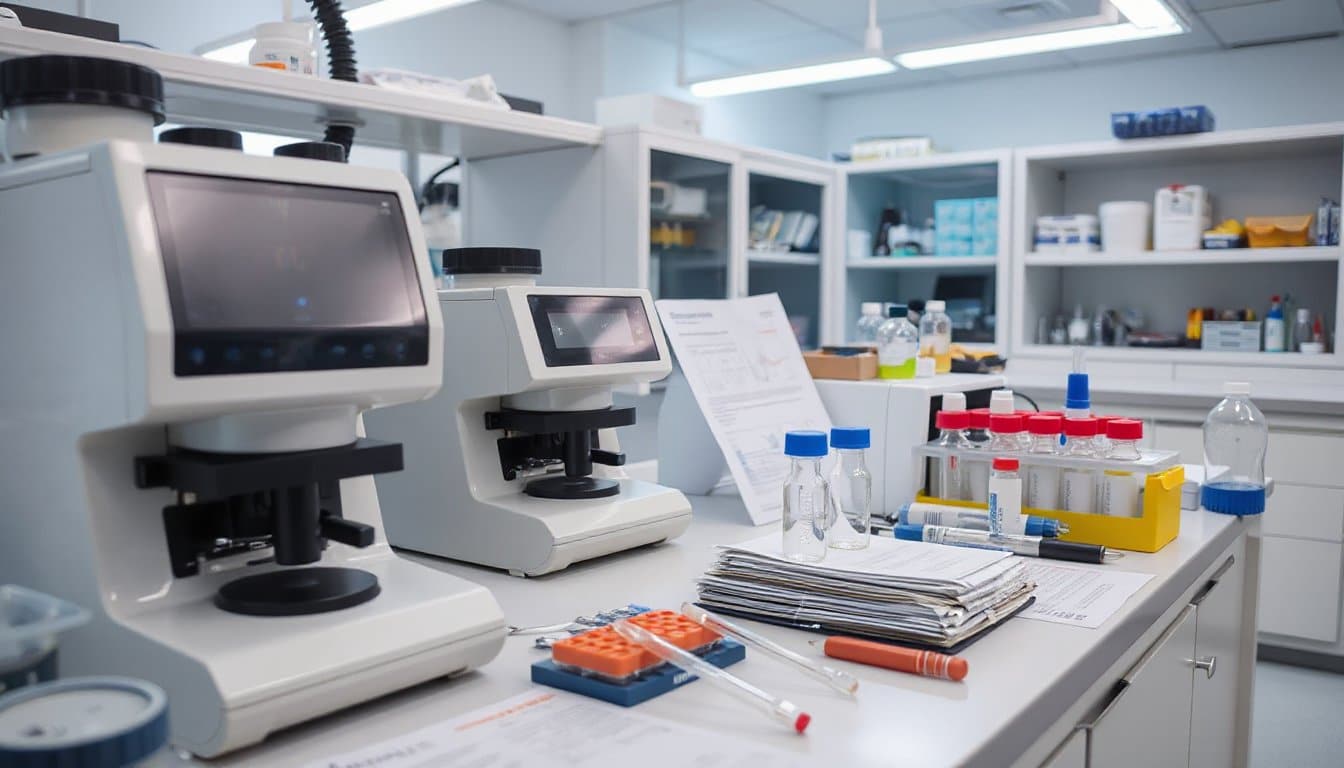
Peptide purity standards vary by application: you select >80% for immunological uses and polyclonal antibody production, >90% for structure-activity studies and bioassays, >95% for in vitro/in vivo tests and early clinical phases, and >98% for GMP materials in late trials or commercial use. You evaluate purity reporting context alongside method details like RP-HPLC conditions, as it affects comparability across batches. Higher purity minimizes off-target effects; you set acceptance criteria purity based on needs, such as 90, 95% for toxicology. For impurity profile interpretation, you scrutinize truncated forms, oxidized residues, and deamidation via validated chromatography per ICH Q3A/B and FDA mandates, ensuring reproducibility and safety. Distinguish purity from net peptide content, which accounts for counterions and moisture, you integrate both for precise dosing. HPLC-MS analysis represents the gold standard for confirming both peptide identity and purity levels across research and pharmaceutical applications, often employing reversed-phase HPLC for superior speed and efficiency in peptide separations. FDA guidances emphasize product characterization details like purity to support peptide drug development safety and efficacy.
Choose Your Detection Method: HPLC, MS, or LC-MS
You select your detection method for peptide purity based on resolution needs, sensitivity, and impurity identification: RP-HPLC quantifies via UV absorbance at 210, 220 nm, where the main peak area integration purity relative to total peaks yields the hplc purity percent. You select your detection method for peptide purity based on resolution needs, sensitivity, and impurity identification: RP-HPLC quantifies via UV absorbance at 210, 220 nm, where the main peak area integration relative to total peaks yields the HPLC purity percent. This analytical approach is also applied in hpic peptide testing workflows to verify peptide quality and detect trace impurities during laboratory evaluation.
> Select peptide purity detection method by resolution, sensitivity, and impurity needs: RP-HPLC quantifies via UV at 210, 220 nm, with main peak area relative to total peaks giving HPLC purity percent.
Choose RP-HPLC for high-resolution separation in complex matrices; you analyze retention times and peak area integration purity, though it omits water/salt and lacks impurity structures.
Opt for MS when you need superior sensitivity and m/z resolution to detect low-abundance ions and confirm molecular weights precisely.
Select LC-MS for integrated lc-ms support, combining separation with structural identification of impurities, enantiomeric purity, and thorough characterization using formic acid.
Select the Right Column and Mobile Phase for Your Peptides
- Imagine soaring summits revealing impurity resolution you’ve chased for hours.
- Feel frustration melt as clean elution reveals your peptide’s true purity.
- Revel in scale-up assurance from reproducible, clog-free separations.
Optimize mobile phase composition with TFA/FA modifiers, ACN gradients (20-90%), and heightened temperatures to refine selectivity and boost loading.
Set Up Your HPLC System: Essential Instrumentation
To set up your HPLC system for peptide purity measurement, you’ll need to configure an analytical instrument paired with a photodiode array detector, such as an Alliance HPLC System with a 2998 detector model, that enables simultaneous UV monitoring at 220 nm and 280 nm. Your analytical column selection, typically a reversed-phase C18 format like XBridge (4.6 × 100 mm), forms the foundation for reproducible separations and future method transfer to preparative scales. System suitability requires optimizing your mobile phase gradient, commonly aqueous trifluoroacetic acid to acetonitrile at pH 2.0, with acetonitrile steepness adjusted between 0.5, 2.0% per minute to achieve adequate peptide resolution without excessive run times.
Essential Components
- Imagine confidently resolving co-eluting impurities that skew peptide purity percentages, achieving publication-ready data.
- Feel the relief of UV wavelength purity detection at 214 nm and 280 nm, unmasking hidden contaminants in real time.
- Revel in peak purity assessments via photodiode array, empowering reproducible research without assay surprises.
Column Selection
C18 columns form your starting point for reversed-phase HPLC peptide separations, delivering reliable performance despite occasional tailing with certain proteins. When you encounter peak broadening, C4 columns provide an effective alternative, though they may co-elute hydrophobic impurities. Your column’s carbon load and silica surface characteristics greatly influence selectivity, lower carbon loads amplify polar silanol effects, creating distinct separation profiles. For ideal results, select column length and particle size based on your peptide’s molecular weight; longer columns (250 mm) improve resolution, while 300Å pore sizes accommodate peptides exceeding 1.8 kDa. Smaller particle diameters enhance separation efficiency through increased interaction time. Consider specialized phases like RP-amide or Peptide ES-C18 when standard C18 proves inadequate for your specific peptide class.
System Suitability
- Frustrate irreproducible runs by skipping pump checks, you’ll chase elusive peaks endlessly.
- Risk false purity reads without detector calibration; impurities masquerade as targets.
- Sabotage resolution ignoring mobile phase bubbles; watch baselines ripple in agony.
Validate Your System Before Every Analysis Run
Incorporate retention time analysis by comparing biological peptide retention to synthetic validation standards using linear spline models with flanking internal standards, calculating delta RT to eliminate false positives alongside spectrum analysis. evaluating peptide supplier quality standards is essential for ensuring reliable results in peptide synthesis. Implementing stringent measures can help mitigate risks associated with impurities and inconsistencies, providing confidence in experimental outcomes.
Measure Purity Using UV Detection at 220 Nm

Since peptide bonds absorb ultraviolet light strongly at 214, 220 nm due to their inherent chromophores, you can leverage this property to quantify purity using reversed-phase HPLC with UV detection.
You set detection at 220 nm on a C18 column with water-acetonitrile gradient and 0.1% TFA. Review the UV absorption basis: peptide bonds yield universal signal regardless of sequence; aromatics add higher-wavelength peaks.
Interpret the chromatogram: x-axis shows elution time (minutes), y-axis milli-absorbance units (mAU). A dominant sharp peak signals purity; integrate areas for calculation.
Apply the purity calculation example: target peak at 2,500,000 mAU amid total 2,575,000 mAU gives 97.1%, 97.1% of UV-detectable material is your peptide.
- Spot that crisp peak and feel confidence surge as impurities vanish from your assay.
- Crunch those numbers to banish underdosing fears in sensitive experiments.
- Secure reproducibility knowing you’ve nailed UV purity amid hidden non-absorbers.
Confirm Peptide Identity and Detect Impurities With Mass Spectrometry
Impurity detection capabilities reveal peaks differing from target m/z; you use tandem MS/MS, LC-MS/MS with CID, and extracted ion chromatograms (XIC) to resolve co-eluting species and single amino acid deletions. You interpret b/y ion series, neutral losses (H2O, NH3), and adducts (Na+, K+) via software for automated purity calculation. High-resolution (>10,000 FWHM) supports mass-directed purification, boosting purity from 31% to >92%.
Combine LC and MS for Maximum Sensitivity and Specificity
- Accurate mass LC-MS replaces conventional UV analysis, delivering superior specificity for large molecules and API peak validation
- Detection method effects profoundly influence results, acetic acid ion-pairing and pH 3.5 storage protocols prevent ion suppression and guarantee reproducibility
- Analytical variability decreases noticeably when you implement routine MS source cleaning and HPLC-grade solvents, enabling consistent quantification across batches
Direct injection workflows quantify dozens of peptides within ten minutes, maintaining column performance across hundreds of runs despite complex sample matrices.
Deploy Advanced Techniques: UHPLC, MALDI-TOF, and Ion-Exchange Methods
Deploy UHPLC, MALDI-TOF, and ion-exchange methods to elevate peptide purity assessment beyond standard LC-MS, achieving superior resolution, molecular confirmation, and charge-based separation. You’ll utilize UHPLC with C18 columns (150-250mm, 3-5μm particles), water/acetonitrile mobile phase (0.1% TFA), and UV detection at 220/280 nm; maintain 25-40°C, resolution >1.5, RSD <2.0% for method-dependent purity. Employ MALDI-TOF to verify identity via [M+H]+ ions (±0.1 Da), matching theoretical isotope patterns with minimal sample. Apply ion-exchange HPLC for charge-based distinctions, complementing RP-HPLC, quantifying via peak areas at 210-220 nm.
Shop Research Peptides at Holas Today
If you are looking for research peptides that are properly handled, securely packaged, and shipped with care, Holas has you covered. We provide laboratory-grade peptides with third-party tested purity, reliable packaging standards, and fast shipping to support your research needs. Browse our full catalog or contact us to find the right peptides for you today.
Frequently Asked Questions
What Affects Peptide Purity Calculation Accuracy?
You compromise peptide purity calculation accuracy when sample pretreatment introduces interference, buffers bias results, or concentrations skew nonlinearly. Temperature, humidity, and light degrade stability; uncalibrated equipment or mismatched methods like RP-HPLC miss salts. Human errors, poor training, haste, fatigue, and failure to correct for impurities overestimate content.
How Does Peptide Conformation Impact HPLC Results?
Peptide conformation alters your RP-HPLC results by changing retention times, peak shapes, and purity calculations. You observe longer retention for less helical forms like GELK versus helical GELE due to exposed hydrophobic residues interacting with C18 columns; folded structures internalize them, eluting earlier. You’re evaluating symmetric main peaks for stability, tailing signals conformational issues, while gradients and ligands affect resolution of variants.
What Purity Thresholds Qualify Research-Grade Peptides?
You qualify research-grade peptides at ≥85% purity, as they suit your preliminary studies, method development, and screening. You’ll find suppliers like JPT define it where each peptide appears detectable as the main product via HPLC-MS, while others set ≥95% for high-purity research assays. You verify thresholds through COAs, noting variability; you prioritize this level to minimize costs yet guarantee reproducibility in early experiments.
How to Interpret Purity Across Different Suppliers?
You interpret purity across suppliers by examining the analytical method (e.g., RP-HPLC at 220nm, MS, or UPLC), as it dictates resolution and sensitivity. Compare chromatograms, detection thresholds, and orthogonal confirmations like LC-MS for impurities. Factor in instrument variations and batch consistency; match purity (>98% for high-end, 70-85% for preliminary) to your assay needs while reviewing NPC and documentation.
Why Supplement Purity With Amino Acid Analysis?
You supplement HPLC purity with amino acid analysis (AAA) because HPLC measures only the target peptide relative to UV-absorbing impurities, excluding water, salts, and counter-ions like TFA. AAA hydrolyzes peptides to quantify net content against certified standards, yielding actual peptide mass (typically 70-90%). This guarantees precise dosing for quantitative assays, complementing purity for reproducibility.